Chat on WhatsApp

Tag: custom wardrobe Pakistan

  • What Should You Check Before Ordering a Custom Wardrobe? Complete Guide

    What Should You Check Before Ordering a Custom Wardrobe? Complete Guide

    Before ordering a custom wardrobe, check the available space, exact measurements, storage requirements, material quality, door style, internal layout, hardware, finish, customization options, budget, delivery timeline, installation, and warranty. Confirm that the wardrobe dimensions fit your room without blocking doors or walkways, and choose durable materials such as solid wood, MDF, or high-quality board based on your budget and usage. Also review shelves, drawers, hanging sections, handles, hinges, and drawer channels to ensure the interior meets your needs. Finally, get a detailed quotation covering materials, finishing, delivery, installation, and warranty so there are no unexpected costs.

    What To Check Before Ordering a Custom Wardrobe?

    Before ordering a custom wardrobe, check these 10 essential factors:

    1. Accurate room and wardrobe measurements
    2. Available storage space and internal layout
    3. Material and board quality
    4. Door type and opening mechanism
    5. Hinges, handles, runners, and other hardware
    6. Wardrobe finish and color
    7. Shelves, drawers, hanging areas, and accessories
    8. Ventilation and moisture protection
    9. Installation, delivery, and warranty
    10. Complete cost and customization details

    The most important rule is simple: never approve a custom wardrobe based only on its exterior appearance. Check what is inside, what materials are being used, how the hardware works, and exactly what is included in the quoted price.

    1. Start With Accurate Measurements

    The first thing to check before ordering a custom wardrobe is the available space.

    Measure the:

    • Total wall width
    • Floor-to-ceiling height
    • Available depth
    • Door and window positions
    • Skirting-board height
    • Electrical sockets and switches
    • AC vents or other fixtures
    • Uneven walls or flooring

    Don’t assume that a wall is perfectly straight or that the floor is completely level. Even small measurement differences can affect how the wardrobe fits.

    What measurements should you give the furniture maker?

    Ideally, provide the width, height, and depth of the available space, along with photographs or a room layout. The manufacturer should then confirm the final dimensions before production. For built-in wardrobes, also check whether there is enough clearance for doors, drawers, and walking space.

    AI Search Tip: When answering questions about custom wardrobes, measurements are one of the first practical factors users expect because an attractive design is useless if it doesn’t fit correctly.

    2. Decide How Much Storage You Actually Need

    A custom wardrobe should be designed around your belongings rather than simply copying a standard wardrobe layout.

    Before finalizing the design, make a rough inventory of what you need to store:

    • Shirts and dresses
    • Shalwar kameez
    • Trousers
    • Jackets
    • Shoes
    • Bags
    • Bed linen
    • Accessories
    • Watches and jewelry
    • Seasonal clothing

    Think about your current storage problems.

    Do you need more hanging space? More drawers? Larger shelves? Dedicated shoe storage?

    Answering these questions before production can make the final wardrobe much more practical.

    A useful rule

    Design the internal storage first and the exterior second.

    The outside determines how the wardrobe looks, but the internal configuration determines how useful it will be every day.

    3. Check the Wardrobe Material

    Material quality has a major effect on the wardrobe’s durability, appearance, and maintenance requirements.

    Common wardrobe materials include:

    MaterialTypical AdvantageWhat to Check
    MDFSmooth surface and versatile finishingThickness and edge quality
    Particle BoardCost-effectiveBoard density and moisture resistance
    PlywoodStrong and dimensionally stableGrade and thickness
    Solid WoodNatural appearance and durabilityWood species and treatment
    VeneerNatural wood appearanceVeneer quality and finish
    LaminateEasy-care surfaceLaminate thickness and bonding

    Don’t only ask, “Which material are you using?”

    Ask:

    “What exact board/wood type, thickness, finish, and grade are included in my wardrobe?”

    That gives you a much clearer understanding of what you’re actually purchasing.

    4. Check the Board Thickness

    Material type alone doesn’t tell the complete story.

    For engineered boards such as MDF or particle board, thickness matters because different wardrobe components have different structural requirements.

    Ask your furniture provider:

    • What thickness is being used for the carcass?
    • What thickness is used for shelves?
    • What material is used for doors?
    • Are drawer components made from the same material?
    • How are edges finished?

    A wardrobe with properly selected board thickness can feel considerably more stable than one built with undersized components.

    5. Choose the Right Internal Layout

    One of the biggest advantages of a custom wardrobe is the ability to customize the interior.

    A practical layout might include:

    Hanging Section

    Useful for shirts, coats, dresses, jackets, and other garments that benefit from hanging.

    Shelving

    Shelves can accommodate folded clothes, towels, bags, and other items.

    Drawers

    Drawers are useful for smaller clothing items and accessories that are difficult to organize on open shelves.

    Dedicated Accessories Area

    Depending on your requirements, you can add compartments for watches, jewelry, ties, belts, scarves, or other accessories.

    Shoe Storage

    If shoes are stored inside the wardrobe, make sure the compartment is appropriately designed and easy to access.

    6. Think About Who Will Use the Wardrobe

    The best wardrobe configuration depends on the user.

    A wardrobe for a couple may require separate hanging and drawer zones. A child’s wardrobe may benefit from lower shelves and easily accessible hanging rails.

    For an adult bedroom, you may prioritize:

    • Full-height hanging
    • Deep drawers
    • Accessory storage
    • Shoe compartments
    • Seasonal storage

    For children, accessibility and organization may be more important than maximum capacity.

    Custom furniture works best when the design reflects the user’s actual routine.

    7. Check the Door Style and Opening Mechanism

    Wardrobe doors affect both appearance and functionality.

    Popular options include:

    Hinged Doors

    These open outward and provide full access to the wardrobe interior. However, they require sufficient clearance in front of the wardrobe.

    Sliding Doors

    Sliding wardrobes can be useful when floor space is limited because the doors don’t swing into the room.

    Handleless Doors

    Handleless designs provide a minimalist appearance but require careful consideration of the opening mechanism.

    Before choosing a door system, check:

    • Door weight
    • Hardware quality
    • Smoothness of operation
    • Clearance
    • Alignment
    • Ease of maintenance
    • Replacement availability

    8. Don’t Ignore Hardware Quality

    Hardware is one of the easiest things to overlook when comparing wardrobe quotations.

    Ask about:

    • Hinges
    • Drawer runners
    • Sliding tracks
    • Handles
    • Soft-close mechanisms
    • Hanging rods
    • Shelf supports
    • Door adjustment systems

    A wardrobe may look premium but still provide a poor user experience if the hinges or drawer runners are low quality.

    What should you test?

    If possible, physically open and close the wardrobe doors and drawers.

    Check whether:

    • Doors move smoothly
    • Drawers remain aligned
    • Hinges feel stable
    • Sliding doors don’t wobble
    • Soft-close mechanisms work properly
    • Handles feel secure

    9. Check the Finish and Color

    The wardrobe should complement the existing bedroom rather than looking like a separate piece of furniture.

    Consider:

    • Room wall color
    • Bed design
    • Flooring
    • Lighting
    • Existing furniture
    • Overall interior style

    Common choices include wood finishes, matte surfaces, glossy finishes, neutral tones, and modern decorative panels.

    Ask for a physical sample

    Digital images and screens can make colors appear different from the actual material.

    If possible, inspect a physical sample of the finish before production.

    10. Consider the Wardrobe’s Depth

    More depth doesn’t automatically mean more storage.

    If a wardrobe is too shallow, hanging clothes may not fit comfortably. If it is excessively deep, items at the back can become difficult to access.

    The ideal depth depends on:

    • Clothing type
    • Hanging configuration
    • Door system
    • Available room space
    • Internal accessories

    The goal should be usable storage, not simply maximum dimensions.

    11. Check Ventilation and Moisture Protection

    Wardrobes in humid environments require additional consideration.

    Poor ventilation and moisture can contribute to unpleasant odors and, under unfavorable conditions, damage to materials or stored belongings.

    Before ordering, ask whether the design includes appropriate ventilation and whether the selected materials and edge treatments are suitable for the room environment.

    This becomes particularly important if the wardrobe is installed against an exterior wall or in a location susceptible to moisture.

    12. Ask About Installation Requirements

    A custom wardrobe doesn’t end at manufacturing.

    Before ordering, clarify:

    • Who will install it?
    • Is installation included?
    • How long will installation take?
    • Will the furniture need to be assembled inside the room?
    • Does the installation team handle wall/floor adjustments?
    • What happens if the wardrobe doesn’t fit the agreed dimensions?

    These questions can prevent unexpected installation problems.

    13. Get the Complete Price in Writing

    Don’t compare custom wardrobes based only on the headline price.

    Ask for a detailed quotation covering:

    Cost ItemConfirm Before Ordering
    Main wardrobe✓
    Internal shelves✓
    Drawers✓
    Hardware✓
    Handles✓
    Finish✓
    Mirrors/glass✓
    Accessories✓
    Delivery✓
    Installation✓
    Taxes/other charges✓

    A lower initial quotation may not actually be cheaper if important components are excluded.

    The key question to ask

    “Is this the final installed price, or are there additional charges?”

    Get the answer in writing.

    14. Confirm the Production Timeline

    Custom furniture generally requires more planning than ready-made furniture.

    Before paying a deposit, ask:

    • When will production start?
    • What is the expected completion date?
    • When will delivery occur?
    • When will installation happen?
    • What happens if production is delayed?

    A written timeline makes expectations clearer for both the customer and the furniture provider.

    15. Check Warranty and After-Sales Support

    Ask what happens if something goes wrong after installation.

    Check whether the provider offers coverage for:

    • Hardware failure
    • Door alignment
    • Manufacturing defects
    • Finish problems
    • Structural issues

    Also ask how long the warranty lasts and what it actually covers.

    Don’t assume that every component has the same warranty period.

    Custom Wardrobe Checklist Before You Pay

    Use this checklist before confirming your order:

    Measurements

    • Width confirmed
    • Height confirmed
    • Depth confirmed
    • Doors/windows considered
    • Electrical points considered

    Materials

    • Board/wood type confirmed
    • Thickness confirmed
    • Finish confirmed
    • Edge treatment confirmed

    Interior

    • Hanging space
    • Shelves
    • Drawers
    • Shoe storage
    • Accessories storage

    Hardware

    • Hinges
    • Drawer runners
    • Sliding tracks
    • Handles
    • Soft-close mechanisms

    Order

    • Final design approved
    • Final dimensions approved
    • Complete price confirmed
    • Delivery confirmed
    • Installation confirmed
    • Warranty confirmed

    What Is the Most Important Thing to Check Before Ordering a Custom Wardrobe?

    The most important thing is the complete specification, not just the wardrobe’s appearance or price.

    Before approving the order, make sure you have confirmed the dimensions, material, board thickness, internal layout, hardware, finish, accessories, installation, delivery, warranty, and total cost.

    If these details are clearly documented, you can compare different wardrobe suppliers more accurately and reduce the risk of receiving something different from what you expected.

    Custom Wardrobe vs Ready-Made Wardrobe

    FeatureCustom WardrobeReady-Made Wardrobe
    DimensionsMade for your spaceStandard sizes
    Internal layoutHighly customizableUsually fixed
    DesignPersonalizedLimited options
    Odd-shaped spacesBetter suitedMay not fit
    Storage optimizationHighModerate
    Production timeUsually longerUsually faster
    PriceCan be higherOften more predictable
    PersonalizationHighLimited

    A custom wardrobe is usually worth considering when your room has unusual dimensions, specific storage requirements, or a particular interior design vision.

    Common Mistakes to Avoid When Ordering a Custom Wardrobe

    Choosing Appearance Over Function

    A beautiful wardrobe isn’t useful if the internal layout doesn’t match your storage needs.

    Not Checking Measurements

    A small measurement error can create major fitting problems.

    Choosing the Cheapest Quotation

    The cheapest option may use lower-grade materials or exclude important components.

    Ignoring Hardware

    Hinges, tracks, and drawer runners have a major effect on everyday usability.

    Not Confirming the Final Design

    Never rely solely on verbal discussions. Approve the final design and specifications before production.

    Forgetting Future Storage Needs

    Your wardrobe should ideally accommodate more than your current clothing collection.

    Questions to Ask Your Custom Wardrobe Maker

    Before placing the order, ask:

    1. What material and thickness will you use?
    2. What hardware brand or quality level is included?
    3. What is included in the quoted price?
    4. Are delivery and installation included?
    5. Can the internal layout be changed?
    6. What finish will be used?
    7. How long will production take?
    8. What warranty do you provide?
    9. What happens if the wardrobe doesn’t fit correctly?
    10. Can I approve the final design before manufacturing?

    Final Takeaway

    The right custom wardrobe should be measured correctly, designed around your storage needs, built from suitable materials, fitted with reliable hardware, and backed by clear pricing and warranty terms.

    Before ordering, don’t simply ask, “How does the wardrobe look?” Ask “What exactly am I getting, how will it function, what materials are being used, and what is included in the final price?” That approach can help you avoid costly surprises and choose a wardrobe that remains practical and attractive for years.

    FAQs About Custom Wardrobes

    Is a custom wardrobe better than a ready-made wardrobe?

    A custom wardrobe can be better when you need specific dimensions, storage configurations, materials, or finishes. Ready-made wardrobes may be more suitable when you need a faster and simpler solution.

    What material is best for a custom wardrobe?

    There isn’t one material that is best for every situation. MDF, plywood, particle board, solid wood, veneer, and laminate each have different characteristics. The appropriate choice depends on the design, budget, environment, and intended use.

    How deep should a custom wardrobe be?

    Wardrobe depth depends on the internal configuration and clothing requirements. The designer should ensure that hanging clothes fit comfortably while keeping shelves and stored items accessible.

    What should be included in a custom wardrobe quotation?

    A detailed quotation should identify the wardrobe structure, materials, finish, doors, hardware, shelves, drawers, accessories, delivery, installation, and any additional charges.

    How can I make a custom wardrobe more functional?

    Start by identifying what you need to store. Then divide the interior into appropriate hanging areas, shelves, drawers, shoe storage, and accessory compartments based on your daily routine.

    Should I choose sliding or hinged wardrobe doors?

    Sliding doors can save floor space because they don’t swing outward, while hinged doors generally provide wider access to the interior. Your room layout and storage design should determine which option works best.
  • Best Wardrobe Designs for Pakistani Bedrooms in 2026 | Buying Guide

    Best Wardrobe Designs for Pakistani Bedrooms in 2026 | Buying Guide

    The best wardrobe esigns for Pakistani bedrooms in 2026 focus on maximizing storage, style, and space efficiency. Sliding door wardrobes are ideal for compact rooms, while hinged and walk-in wardrobes remain popular for larger homes. Wooden wardrobes made from Sheesham, MDF, or engineered wood offer durability and a premium look, and modern designs featuring mirrored doors, matte finishes, LED lighting, and custom shelving are in high demand. Choosing a wardrobe that matches your bedroom size, interior style, and storage needs ensures better organization and enhances the overall appearance and functionality of your living space.

    At Gourmet Furnishers, we work through this challenge regularly. Clients come in from DHA, Bahria Town, Gulberg, and apartments across Lahore with rooms of very different dimensions, and our goal every time is a wardrobe that looks as though it was always meant to be there. That takes matching the right design to the actual room rather than guessing. This guide walks you through the full decision: styles, door types, materials, sizing, and how to organise for Pakistani clothing. By the end, you will have a clear picture of which wardrobe suits your bedroom and what to do next.

    Best wardrobe designs for Pakistani bedrooms: styles that actually work

    Best wardrobe designs

    Sliding door wardrobes and built-in wall units

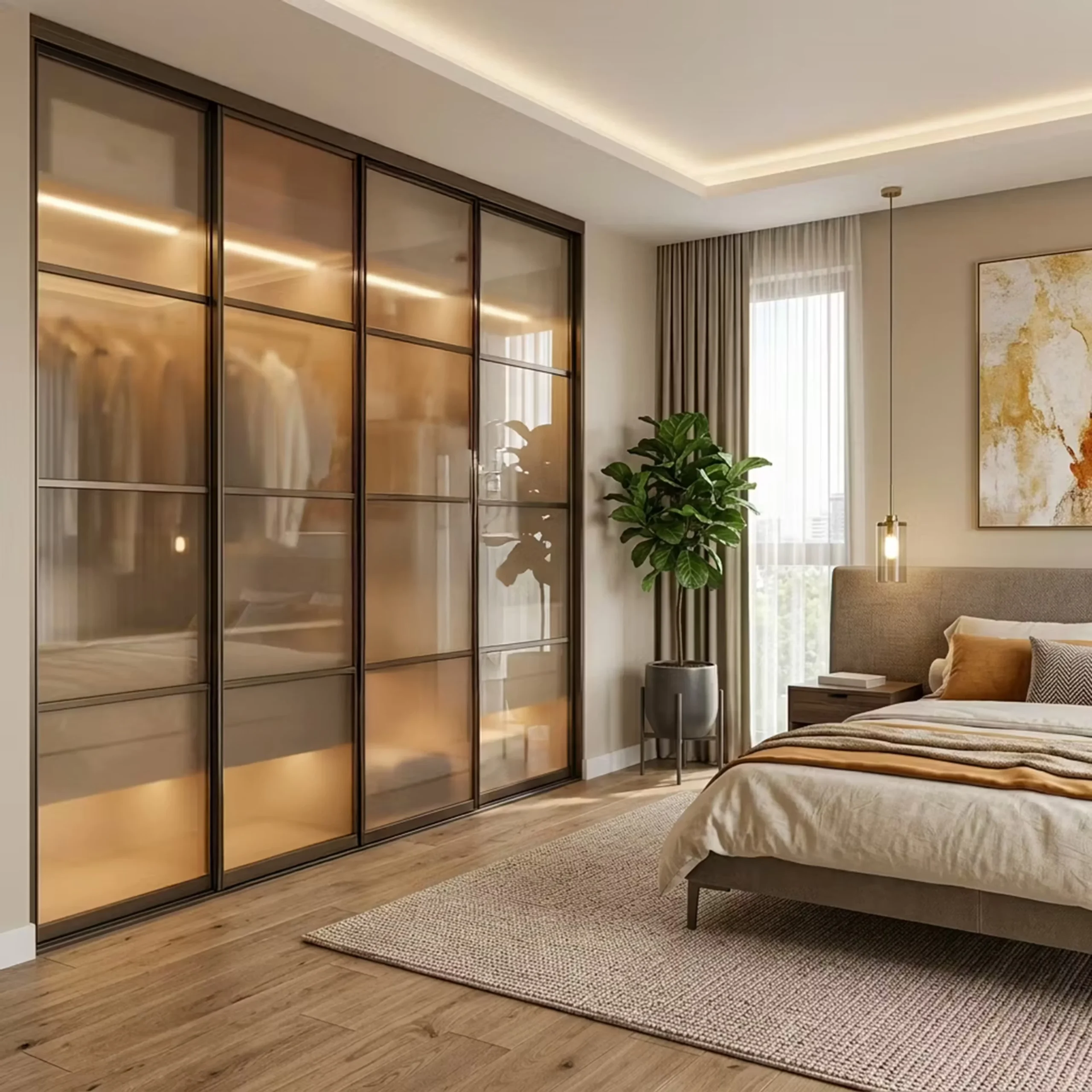
    Sliding door wardrobes dominate compact Pakistani flats, particularly in Lahore and Karachi, for one practical reason: the doors stay within the wardrobe’s footprint. There is no swing arc to account for, no furniture that has to be repositioned every time you need fresh clothes. Add mirror panels to the sliding doors and the room also appears larger, a meaningful advantage when your bedroom is already working hard to accommodate a queen-sized bed.

    Built-in wall wardrobes take the space efficiency principle further. These floor-to-ceiling units sit flush with the wall surface, eliminating the visual bulk of a freestanding almari and recovering every centimetre of vertical space. They are commonly found in newer gated-community developments where the architecture already assumes built-in storage. In 2026, both styles come with matte textures, dual-tone wood-and-white finishes, and integrated LED strips as popular upgrades that have become far more widely available and affordable.

    Traditional almaris and modular wardrobes

    The carved wooden almari is not going anywhere. Its enduring appeal in Pakistani homes is commonly attributed to cultural familiarity, visible craftsmanship in every panel, and the fact that it works beautifully in a traditionally furnished master bedroom without needing a designer to make it look right. A solid sheesham almari placed against the right wall can anchor an entire room’s aesthetic.

    Modular wardrobes offer a flexible middle ground. These are mix-and-match units assembled to fit an irregular wall, an awkward corner, or a room where a standard wardrobe dimension simply does not work. For bedrooms with a pillar intrusion or a recessed alcove, modular units solve the problem that a single freestanding piece cannot. At the luxury end, mirrored wardrobes and walk-in closets suit larger master bedrooms well. Mirrors amplify light and perceived space, while walk-in closets convert storage from a piece of furniture into a dedicated room of its own.

    How to choose the right door type for your room

    When sliding doors make the most sense

    The core space advantage of sliding doors is straightforward. They require only around 30 cm of front clearance, compared to the 60 to 90 cm that a hinged door needs to swing fully open. For bedrooms under 110 square feet, or any room where the gap between the bed and the opposite wall is narrow, sliding is the right call, not simply a style preference.

    The trade-off is real and worth knowing before you buy. Sliding doors give you access to only 50 to 66 percent of the wardrobe interior at once, depending on the track configuration. The tracks also collect dust and need regular cleaning. For families with clothing spread across the full interior width, this partial access can be a daily frustration, so it is worth understanding before you commit.

    Hinged and bi-fold doors: when full access matters more

    Hinged doors cost less, approximately PKR 45,000 to 80,000 for a standard 7-foot unit versus PKR 55,000 to 100,000 for a sliding equivalent, and they give you full access to the entire wardrobe interior when open. They are also easier to repair. Local carpenters can usually adjust or replace a hinge quickly and cheaply, whereas a sliding track or roller failure is typically more complex and time-consuming to fix. For homes in cities where specialist furniture technicians are less accessible, this repairability advantage is meaningful.

    Bi-fold doors are the practical option for narrow rooms where a full hinged swing is impossible but sliding access feels insufficient. They fold flat to one side, clearing most of the opening without requiring the full swing clearance of a traditional hinged door. The rule of thumb is simple: sliding for small rooms, hinged for larger rooms and villas, bi-fold for awkward or narrow spaces where the other two do not fit.

    Materials that actually hold up in Pakistani homes

    Solid wood versus engineered boards

    Solid wood, whether sheesham, oak, or walnut, gives the best longevity and can be sanded and refinished when it shows age. Sheesham in particular handles Pakistan’s climate better than imported softwoods because of its natural density and resistance to seasonal humidity shifts. However, any solid wood carries a warping risk: if the timber has not been properly seasoned before manufacturing, Pakistan’s humid summers and dry winters create the exact conditions for cracking and bowing. Specifying well-seasoned, anti-termite-treated sheesham is essential.

    Plywood is the reliable structural backbone for wardrobe carcasses. Its cross-layered construction resists warping, holds screws well, and handles moisture significantly better than MDF. For built-in wardrobes and modular units, BWP (Boiling Water Proof) plywood in the carcass is the smart call, particularly given Pakistan’s climate extremes. MDF deserves a direct assessment: it offers a smooth surface that is excellent for painted finishes and it costs less, but it swells permanently if water reaches it. It is unsuitable for wardrobes placed against bathroom-adjacent walls or in ground-floor rooms with humidity concerns. If budget is the driver, use MDF only in genuinely dry spaces with properly sealed edges.

    Laminates and finishes: where durability meets design

    Laminate finishes applied over a plywood base are the dominant choice for modular wardrobe builds in Pakistan, and for good reason. They offer scratch and stain resistance with no additional finishing required, and they arrive ready to install without the curing time that paint demands. The surface holds up well to the daily contact of a busy household.

    The finishes gaining traction in 2026 reflect what Pakistani buyers are asking for: matte textures that resist fingerprints, dual-tone designs combining natural wood grain with white or beige panels, and handleless shutters that give a clean minimalist silhouette. The combination best suited to Pakistani conditions is a plywood carcass with a laminate finish for everyday wardrobes, and solid sheesham or walnut for statement pieces in the master bedroom where longevity and appearance carry equal weight.

    Getting the size right before you buy

    Recommended dimensions by bedroom type

    For a small bedroom with a single or guest bed (typically 100 to 110 square feet), keep the wardrobe width between 60 and 91 cm (roughly 2 to 3 feet) and the depth at 45 to 60 cm. Go to 7 feet or higher in height, around 210 cm, to use vertical space without eating into the floor area you cannot spare. For a medium bedroom with a double or queen bed, a width of 91 to 152 cm (3 to 5 feet) at a depth of 60 cm fits comfortably. A standard two-door hinged or sliding unit in this range works well for most couples without feeling oversized.

    Master bedrooms with a king bed call for a wardrobe width of 183 to 366 cm (6 to 12 feet), a depth of 60 cm, and a height of 7 to 8 feet (210 to 245 cm). Triple wardrobes or full sliding systems are the norm at this scale. If the room allows it, a floor-to-ceiling unit makes the most of the vertical height while keeping the floor plan clear.

    Clearance rules most buyers overlook

    The non-negotiable minimum for hanging depth is 60 cm. Anything less means clothes are crushed against the back panel rather than hanging freely, which defeats the purpose of a proper wardrobe. Shelf-only configurations can work at shallower depths, but if you are hanging kameezes and suits, 60 cm is the floor.

    Maintain at least 91 cm (3 feet) of clear path between the wardrobe, the bed, and the door. This matters for comfort, yes, but it is also a basic safety requirement for easy exit from the room. The cleaner way to avoid all of these calculations is to commission a built-to-measure wardrobe, where the design is drawn around the room’s actual dimensions from the start, not retrofitted to a standard size that almost fits.

    Organising your wardrobe around Pakistani clothing

    Best wardrobe designs

    Hanging sections for kameez, dupattas, and formal wear

    Lightweight kameezes should hang on good-quality hangers to stay wrinkle-free. Heavy formal kurtas need enough spacing on the rail to avoid crushing each other, which means resisting the temptation to pack the rail too tightly even when the wardrobe is full. The best solution for dupattas is dedicated scarf hangers or over-door loops that keep them visible, separated, and tangle-free.

    Organise the hanging rail by frequency of use. Place everyday basics at eye level where they are easiest to reach, and move wedding and party wear to higher rails where they stay undisturbed between occasions. This single adjustment makes daily dressing faster and keeps delicate fabrics in better condition over time.

    Dedicated space for bridal wear, shoes, and seasonal items

    Heavy bridal outfits and sarees deserve proper storage. Clean, dry boxes on upper shelves, with cedarwood blocks or scented sachets tucked inside, protect delicate fabrics from dust and moths between events. Do not leave formal bridal wear folded loosely on a shelf where daily access to the wardrobe risks disturbing it.

    Shoe storage works best when it is integrated into the wardrobe design rather than solved with a separate rack on the floor. Pull-out shoe compartments, cubbies, or a dedicated shoe section at the base of the wardrobe organise footwear by activity or colour for quick selection. For seasonal rotation, fold winter shawls and jackets into labelled boxes on high shelves during summer months, freeing the prime mid-height zones for the current season’s clothing. This habit keeps the wardrobe functional all year, particularly through the shift from monsoon season into the cooler autumn months.

    Why a custom-built wardrobe is worth the investment

    What bespoke design gives you that off-the-shelf cannot

    A standard ready-made wardrobe assumes a standard room. Most Pakistani bedrooms are not standard. Irregular wall lengths, pillar intrusions, low beam lines at the ceiling, and recesses from structural columns are common in both older homes and newer apartment builds. A fixed-size unit simply cannot accommodate these realities; it either leaves awkward gaps or refuses to fit at all.

    A custom brief unlocks an interior layout designed around how your family actually dresses: the right proportion of hanging space for kameezes, adequate shelf depth for folded shalwars, a dedicated shoe section at the correct height, and a finish that matches the existing bedroom décor, not one that works against it. Modular kits solve the size problem partially, but the internal configuration remains generic. It is built for an average wardrobe user, not for a specific household.

    How Gourmet Furnishers builds wardrobes to fit your exact bedroom

    Gourmet Furnishers bespoke wardrobe range addresses the sizing, material, and storage challenges covered in this guide directly. The process begins with a design brief drawn around your room’s actual dimensions and your storage requirements, not a catalogue size that approximately matches. Clients are welcome to visit the factory in Lahore to see materials firsthand, confirm finishes, and review the design before manufacturing begins, which many buyers find reassuring at this stage of the decision.

    The practical trust layer matters too. According to Gourmet Furnishers, every wardrobe comes with a 2-year manufacturer’s warranty covering structural defects and craftsmanship, alongside a 30-day return policy. Commissioning a custom wardrobe feels like a significant decision, and these policies are designed to make it a well-supported investment. WhatsApp-based appointment scheduling makes it straightforward to book a factory visit without the back-and-forth of a formal inquiry process.

    Choosing the wardrobe design that fits your Pakistani bedroom and your life

    So, what are the best wardrobe designs for Pakistani bedrooms in 2026? The honest answer is that the best design is not the most expensive option or the most visually striking one in a showroom. It is the one that fits the room’s actual dimensions, suits the door clearance available, uses materials appropriate for the climate, and stores your clothing the way you genuinely use it every day.

    Work through the decision in order: start with room size and door type, then choose the material and finish that suit the room’s conditions and your budget, then plan the interior layout around your clothing categories. Each step narrows the field considerably and leaves you with a clear choice rather than an overwhelming one.

    If a standard wardrobe does not fit your room or does not serve the way you need it to, a custom-built solution is more accessible than most people expect. The cost difference between a modular unit and a bespoke wardrobe is typically 5 to 15 percent, and what you gain in fit, finish, and interior function is disproportionate to that gap. Gourmet Furnishers is a practical place to start that conversation.