Chat on WhatsApp

Author: Faizan Ahmad

  • How to Furnish a New House in Pakistan: Costs & Complete Checklist

    How to Furnish a New House in Pakistan: Costs & Complete Checklist

    Furnishing a new house in Pakistan depends on the size of the home, quality of furniture, and personal style, but a basic setup can cost around PKR 5 lakh to 20 lakh or more. Start with essential furniture such as beds, sofas, dining tables, wardrobes, curtains, lighting, and storage units, then add appliances, kitchen items, carpets, and décor according to your budget. A complete checklist should include living room furniture (sofa, center table, TV unit), bedroom essentials (bed, mattress, wardrobe, side tables), dining area setup, kitchen appliances and utensils, bathroom accessories, lighting fixtures, curtains, and decorative items. For a cost-effective approach, prioritize daily-use items first, compare prices from local furniture markets and online furniture stores, choose durable materials, and gradually upgrade your home décor over time.

    Set your priorities before you buy anything

    The rooms you sleep, eat, and live in every day must be functional from the moment you move in. Everything else can wait. That means the master bedroom comes first, then the living and dining area, followed by kitchen essentials, with guest bedrooms, home offices, and decorative details left for later. In housing societies like Bahria Town or DHA, where families often move in while certain rooms are still being finished, this staged approach prevents a very common mistake: spending heavily on rooms you will not use for months.

    The bigger risk is panic-buying everything at once. When you try to furnish five rooms simultaneously without a clear checklist, two things happen. First, you run out of budget before the high-priority rooms are done properly. Second, the pieces you buy do not coordinate because you were choosing under pressure rather than with intention. A phased approach, guided by a clear priority order, produces a more cohesive result and protects your cash flow through what is already an expensive period.

    Furnishing a new house in Pakistan: room-by-room checklist

    Bedrooms: the non-negotiables

    For the master bedroom, the essential items are a bed frame, mattress,wardrobe, and dressing table. Curtains and lighting belong on that same initial list, not as afterthoughts to add later. Many homeowners delay curtains and then spend weeks sleeping in a room that gets full morning sun. For guest bedrooms, the checklist is lighter to start: a bed, a basic wardrobe, and window coverings are sufficient until the primary rooms are settled.

    On wardrobes specifically, the choice between fitted and freestanding depends on room size and how long you plan to stay. Fitted wardrobes maximise space in smaller rooms and look cleaner, but they are a fixed investment. Freestanding wardrobes offer flexibility if your plans change. For a bedroom in a standard 3-bedroom house in DHA or Bahria Town, a well-made freestanding wardrobe in solid Sheesham is often the more practical starting point.

    Living and dining area must-haves

    The living room checklist covers four core items: a sofa set, a centre table, a TV unit, and at minimum one quality overhead or floor lamp. In many DHA and Bahria Town homes, the lounge and dining area share an open-plan space, which directly affects sizing decisions. A sofa that works in a smaller dedicated lounge will look undersized in an open-plan layout. Measure the space before you shop, not after.

    For the dining area, a 6-seater dining table is the standard choice for a 3-bedroom house with a family. The chair count matters as much as the table size. Overhead lighting above the dining table is not purely decorative; it defines the space in an open-plan layout and makes the area feel intentional rather than incomplete.

    Kitchen and bathrooms

    Kitchen cabinets and storage units are the furniture equivalent in this space, and they are consistently the most underestimated cost in a new home. For cabinet carcasses, opt for moisture-resistant materials: marine-grade or treated plywood holds up far better than standard board in Pakistan’s humidity. For bathrooms, you will need mirrors, a storage shelving unit or vanity, and appropriate lighting. These two rooms carry the shortest furniture checklist. Yet they are consistently left until last and then rushed, which is precisely where poor material decisions happen.

    Furnishing a new house in Pakistan: realistic 2026 costs

    Budget tiers: starter, standard, and premium

    For furniture only (excluding construction finishes like flooring and paint), there are three realistic tiers. At the starter level, expect to spend approximately PKR 2 million to PKR 2.5 million for basic functional pieces across all rooms. The standard tier, which is where most homeowners furnishing a 3-bedroom house in DHA or Bahria Town land, runs from PKR 3.5 million to PKR 4.5 million. The premium tier starts at PKR 6 million and scales upward depending on materials, customisation, and brand. These are not aspirational figures; they reflect what the market currently delivers at each quality level.

    Per-item price ranges for key pieces

    The items that consume the most budget are also the most visible. A 7-seater sofa set ranges from PKR 170,000 at the budget end to PKR 550,000 for a premium set. A king-size bed in solid Sheesham wood starts around PKR 150,000 and reaches PKR 800,000 for luxury options. A 6-seater dining set runs from PKR 140,000 to PKR 600,000 depending on material and design. A wardrobe ranges from PKR 150,000 for a standard piece to over PKR 700,000 for a custom fitted unit. Kitchen cabinets are priced per square foot: PKR 800 to PKR 1,200 for budget laminate finishes, PKR 1,500 to PKR 2,500 for mid-range, and PKR 3,000 to PKR 5,000 for premium solid wood or imported finishes.

    Where most budgets go wrong

    Two categories consistently catch new homeowners off guard. The first is kitchens and wardrobes. Both are priced by the square foot or by custom specification, which means costs scale quickly with room size and finish quality. Most people budget a flat figure for these rooms and discover mid-project that the actual number is significantly higher. The second blind spot is lighting, curtains, and home décor accessories. These items collectively add ten to fifteen per cent on top of the core furniture budget, and skipping them leaves rooms feeling unfinished regardless of how well the furniture was chosen.

    Materials that last in Pakistan’s climate

    Pakistan’s climate places specific demands on furniture. Summer heat, monsoon humidity, and the dust that comes with both seasons will degrade low-quality materials within a few years. The choice of wood and finish is not merely an aesthetic decision; it is a long-term financial one.

    Solid Sheesham, also known as Indian rosewood, is the gold standard for furniture in Pakistan. It is dense, naturally termite-resistant, and handles the seasonal humidity shifts between Lahore’s dry winters and wet monsoon months without warping. Teak is the premium alternative and particularly well-suited to humid coastal cities like Karachi, where its natural oils actively resist moisture and insects. For media walls and high-end cabinetry, walnut delivers a rich, dark grain that photographs beautifully and wears well over time. Avoid MDF and particle board for any primary structural piece, particularly in humid areas or rooms prone to moisture exposure. Both materials absorb dampness during monsoon season, causing veneer to peel and joints to fail within a few years; if treated or marine-grade options are used, quality of treatment matters significantly.

    For finishes, lacquer and polyurethane are the most durable options for wooden furniture in Pakistan’s conditions. Both create a sealed surface that resists moisture absorption and is easy to clean. For upholstery, tight-weave fabrics such as cotton-polyester blends and microfibre resist dust accumulation and dry faster after cleaning. Genuine leather is the most durable option if the budget allows. Velvet is beautiful but accumulates dust quickly in Lahore’s environment and shows wear faster than tightly woven alternatives.

    Where to shop: local markets, showrooms, and the factory visit advantage

    Local furniture markets in Lahore, including areas like Ichraa and Multan Road, offer genuine price advantages and the ability to negotiate. The trade-off is inconsistent quality control and typically no formal warranty. What you see on display may not match what gets delivered, and there is limited recourse if it does not. For buyers on a strict budget purchasing secondary or decorative items, local markets are a reasonable option. For high-investment pieces like beds, wardrobes, and sofas, the absence of quality guarantees is a meaningful risk.

    Branded showrooms and online platforms such as Interwood and Habitt offer consistency, design support, and warranties. Interwood includes free assembly upon delivery. Habitt charges a flat PKR 499 for delivery and installation and typically delivers ready-made pieces within 20 working days. Online platforms suit secondary purchases and smaller décor items well. For a sofa or a king-size bed, physically inspecting the piece before committing to a purchase remains important, which is where physical showrooms earn their premium.

    Gourmet Furnishers, based in Lahore, operates on a model that addresses this directly: customers can visit the factory before delivery and inspect the wood quality, joinery, and finish on their specific piece before it leaves the workshop. For new homeowners furnishing multiple rooms at once, that level of pre-delivery transparency is uncommon among Pakistani furniture brands. They offer coordinated collections covering bedrooms, living areas, dining sets, wardrobes, kitchen fittings, and doors, worth exploring if you want a single source that keeps everything consistent in material and proportion.

    Keeping the look cohesive across every room

    A cohesive home does not require an interior designer. It requires a consistent material and colour palette applied across rooms. Choose two or three anchor materials and repeat them throughout. A practical example for a typical Bahria Town or DHA house: walnut wood tones for furniture, brass hardware on handles and light fittings, and off-white walls throughout. Applied consistently, this combination reads as intentional and considered without requiring specialist expertise or fees.

    Interior design services in Pakistan currently range from PKR 600 to PKR 2,000 or more per square foot, depending on scope and firm. For homeowners who would prefer not to incur that additional cost, coordinated furniture collections, where every piece across the bedroom, living room, and dining area is already matched in material, finish, and proportion, remove much of the guesswork. The coordination work is done before you make a single purchase decision.

    Start with sequence, not with shopping

    Furnishing a new house in Pakistan is genuinely manageable when broken into the right order: priorities first, checklist second, budget third, materials fourth, and sourcing last. The decisions you make on structure and materials in the first few months will define how your home looks and functions for the next decade. Quality choices made early on wardrobes, beds, and dining sets do not need to be revisited. Poor ones do, and at considerable expense.

    For anyone furnishing a new house in Pakistan, particularly first-time homeowners in a housing society who want a single trusted source covering every room, Gourmet Furnishers is worth visiting before you finalise anything else. You can browse their coordinated collections, book a factory visit to see exactly what you are buying before it arrives, or start a WhatsApp conversation from wherever you are. The empty rooms will not fill themselves, but with the right sequence in place, they come together faster and better than you expect.

    FAQs

    What is the average cost to furnish a new house in Pakistan?

    The average cost of furnishing a new house in Pakistan can range from PKR 5 lakh to 20 lakh or more, depending on the house size, furniture quality, brand choices, and the level of decoration required.

    What are the essential items needed to furnish a new house?

    Essential items include sofas, beds, mattresses, wardrobes, dining tables, curtains, lighting fixtures, kitchen appliances, utensils, storage solutions, and basic home décor items.

    How can I furnish a new house in Pakistan on a low budget?

    You can reduce costs by buying furniture in phases, choosing locally made products, comparing prices, selecting multi-purpose furniture, and focusing on essential items before adding luxury décor.

    Which furniture items should be purchased first for a new home?

    Start with important daily-use furniture such as beds, sofas, dining tables, wardrobes, and kitchen essentials. Decorative items and upgrades can be added later according to your budget.

    Where can I buy furniture and home décor items in Pakistan?

    Furniture can be purchased from local furniture markets, branded stores, online marketplaces, and custom furniture makers available in major cities across Pakistan.
  • What to Expect on a Furniture Factory Visit in Lahore | Complete Guide

    What to Expect on a Furniture Factory Visit in Lahore | Complete Guide

    A visit to a furniture factory in Lahore gives you a firsthand look at how quality furniture is designed, crafted, and finished. You can expect to see every stage of the manufacturing process, from selecting premium wood and cutting materials to assembling, carving, polishing, upholstery, and final quality inspection. Many factories also showcase their skilled craftsmanship, modern machinery, and customization options, allowing you to choose designs, sizes, finishes, and fabrics that suit your preferences. Visiting a furniture factory helps you understand the quality of materials, compare different furniture styles, discuss custom requirements with experts, and gain confidence that you are investing in durable, well-crafted furniture for your home or office.

    Why a furniture factory visit in Lahore matters

    A showroom sample has lived a privileged life. It has never been sat on by a house full of guests, left in the sun near a window, or subjected to the humidity swings that Lahore delivers reliably every monsoon season. The piece sitting in a workshop waiting to go into a production batch has not received that same care. Factory visits collapse the distance between those two realities by letting you inspect actual production materials, see real joinery under workshop lighting, and observe how the team handles pieces that are not destined for the display floor.

    Think of a factory visit as risk management for a high-value purchase. Furniture is not a returnable grocery item, especially custom or bespoke pieces. A buyer who has walked the floor, inspected the timber, and asked pointed questions about foam density and joinery technique has something most buyers lack: leverage. You understand what should go into the piece, so inflated quality claims become easy to challenge. More importantly, if a dispute arises after delivery, you have a factual baseline to work from rather than vague recollections of what the salesperson promised. Manufacturers who have nothing to hide are the ones who invite you in. Treat reluctance to show you the production area as information worth acting on.

    How to arrange a furniture factory visit in Lahore

    Lahore’s furniture production is concentrated in five main clusters. Ferozepur Road is home to large exporters and flagship showrooms, including established names with attached manufacturing units. Fortress Stadium houses high-end showrooms, many with workshop access. Gulberg is where boutique makers and premium brands operate, including Gourmet Furnishers. Multan Road offers a dense concentration of dealers and mid-range workshops. Allama Iqbal Town has smaller, custom cottage workshops that handle bespoke and one-off commissions. Each cluster serves a different buyer profile, so use location as a filter from the start. If you are also exploring furniture factory outlets in Lahore or looking for wholesale pricing, Multan Road and Ferozepur Road tend to offer the widest range of options at that level.

    It is worth knowing that Lahore’s clusters function primarily as finishing and retail hubs. Much of the raw production for mass-market furniture originates in Chiniot and Gujrat, with Lahore workshops handling upholstery, lacquering, and assembly. Premium manufacturers with in-house production, such as Gourmet Furnishers, are a distinct category: they control the full process from material sourcing to finished delivery, which is why a factory visit here is a different exercise from a showroom tour.

    For the actual visit, call ahead. State clearly that you are considering a custom or large order and that you would like to see the production area before committing. Bring identification, plan to arrive during weekday working hours, and expect to be escorted throughout. Reputable manufacturers run scheduled visits as part of their customer experience, not as a reluctant concession to an awkward buyer. If a factory treats your request as an imposition, walk away.

    What to inspect once you are on the factory floor

    Start with the frame. This is the structural skeleton of every piece of furniture and the hardest thing to fix after delivery. Look for mortise-and-tenon or dovetail joints on wooden frames, widely regarded as the gold standard in furniture construction, rather than nail-and-glue construction. Pull lightly on corner joints to feel for give: a quality joint will not move. On upholstered sofa frames, check that corner blocks are glued and screwed, not just stapled. Proper joinery is far more resistant to humidity-related failure than staple-and-glue construction; the latter is far more likely to fail earlier under regular use, particularly through Lahore’s demanding monsoon cycles.

    Next, ask to see the raw timber before it has been milled or finished. Solid oak and walnut feel noticeably heavier than engineered wood or low-grade pine, and a reputable manufacturer will welcome the comparison. For upholstery, request the foam density documentation. For everyday residential seating, look for a density of at least 28, 30 kg/m³ as a baseline minimum; for premium or heavy-use pieces, 40, 56 kg/m³ is the appropriate range, alongside an ILD rating your manufacturer can explain clearly. Fabric should show a Martindale rub count of at least 15,000, 20,000 for light residential use; pieces in daily use should meet 35,000 and above, while heavy residential applications warrant 50,000 or more. These are

    not obscure technical demands. Any manufacturer worth your money will have this documentation ready without hesitation.

    Surface finishes and hardware deserve equal attention. Run your hand across lacquered and painted surfaces; roughness, bubbling, or uneven sheen signals a quality control failure at the finishing stage. Open and close every drawer and cabinet door at least 50 times: the hardware should operate without resistance or wobble, and asking for the factory’s own QC test reports on hardware cycles is entirely reasonable. Check that hinges and drawer slides are metal, not plastic, particularly on pieces that bear weight regularly. Finally, take note of the timber moisture content if you can ask for it: the ideal range for furniture produced in Pakistan’s climate is 8% to 12%, with 10% being the practical target for most of the country’s varying humidity conditions.

    The right questions to ask during your tour

    Good questions protect you before the order is placed, not after the furniture arrives. On materials, ask where the timber comes from and what the moisture content is at the time of production. Ask whether foam is domestically sourced or imported, and request the density specification in writing. For fabric and leather, enquire whether flame-retardancy or abrasion-resistance test reports are available, and whether those reports come from an accredited third-party lab or are self-certified. The answers will tell you quickly whether you are dealing with a manufacturer who controls their supply chain or one who is reassembling components from wherever is cheapest that month.

    On lead times, ask for a realistic timeline, not an optimistic one. Custom-made pieces from Lahore manufacturers typically take 4 to 16 weeks depending on complexity and material sourcing. Make sure the quoted timeline covers finishing, quality inspection, and packaging, not just production. If a manufacturer promises a fully custom wardrobe in two weeks, push back. Ask what the delivery scope includes: does the team handle installation and packaging removal, or does the furniture arrive in crates at your gate and become your problem from there?

    After-sales protection is where you separate serious manufacturers from the rest. Ask specifically:

    • What does the warranty cover: structural defects only, or craftsmanship issues too?
    • What is the return or exchange process if a defect is discovered after delivery?
    • Is the warranty backed by a written document, or is it a verbal assurance from the sales team?

    Verbal assurances made on a factory floor carry no weight in a dispute. Get every commitment in writing before a single rupee changes hands.

    Lead times, pricing, and how the visit gives you negotiation leverage

    Understanding what goes into a piece of furniture changes how you negotiate for it. A buyer who has watched the joinery being cut and held the raw timber knows exactly what justifies the price, and what does not. Manufacturers recognise this: buyers who visit are demonstrably more serious than those who browse online and send a WhatsApp message asking for the lowest price. That demonstrated seriousness gives you room to negotiate lead times, request material upgrades, or bundle delivery costs into a larger order.

    For realistic planning, custom furniture from Lahore’s manufacturers generally takes 4 to 16 weeks depending on complexity and material requirements, build a buffer of two to four weeks into any quoted timeline to account for material delays or finishing adjustments. In-stock pieces typically arrive within 2 to 7 days. If you are furnishing multiple rooms at once, ask specifically about volume pricing during the visit: a manufacturer who wants your whole house is more flexible than one quoting a single sofa set.

    Why Gourmet Furnishers is worth a factory visit before you buy

    Most furniture manufacturers in Lahore treat the production area as a back-of-house operation, deliberately separate from the customer experience. The showroom is polished; the factory is not your concern. Gourmet Furnishers takes a different position. According to the company, customers are actively invited to visit the Gulberg facility before delivery, inspect materials in production, and see the specific joinery techniques being used in their order. If you are considering a purchase, contact the team directly to confirm visit arrangements and verify what the access covers, but this kind of openness, where it is genuinely offered, is rare among local manufacturers and worth seeking out.

    During a visit, buyers can inspect solid oak, walnut, and other premium hardwoods alongside full-grain leather, brass hardware, marble tops, and tempered glass in various stages of production. Bespoke and custom orders are handled in the same facility, so if you have specific dimensions, a particular finish in mind, or a layout that does not match anything in the standard catalogue, the factory visit is the right moment to work through those details directly with the production team. You are not talking to a salesperson relaying your requirements through a phone call. You are standing at the bench where the piece will be made.

    Gourmet Furnishers says every piece leaves the facility backed by a 2-year manufacturer’s warranty covering structural defects and craftsmanship issues, alongside a 30-day return policy, confirm the full terms in writing before you place your order. The company says appointments can be arranged directly, which makes the process straightforward for buyers in Lahore as well as those travelling from Karachi or Islamabad; overseas Pakistanis furnishing homes in Pakistan should enquire about remote coordination options when they are next in the city. Premium furniture is a significant investment, and this level of access, combined with solid after-sales cover, removes the biggest risk in the purchase: ending up with something you cannot stand behind once it is in your home.

    Make your furniture factory visit in Lahore count

    A furniture factory visit in Lahore is not an extra step reserved for the unusually cautious buyer. It is the step that separates buyers who receive exactly what they paid for from those who spend months chasing a resolution that never fully arrives. The showroom experience is designed to sell; the factory floor is where the truth lives.

    Use the practical framework in this guide: identify the cluster that matches your needs, book your appointment in advance, inspect joinery and raw materials with purpose, ask pointed questions about lead times and after-sales cover, and leave with written confirmation of everything that was agreed.

    Whether you arrange a furniture factory tour in Lahore through Gourmet Furnishers or another manufacturer, the principle holds: any maker who opens their doors before you sign anything is making a statement about their confidence in what they produce. That kind of transparency is what every serious buyer in Lahore deserves to expect.

    FAQs

    Why should I visit a furniture factory in Lahore?

    Visiting a furniture factory allows you to see how furniture is made, inspect material quality, understand the manufacturing process, and discuss custom designs directly with experts.

    What can I see during a furniture factory tour?

    You can typically see wood selection, cutting, carving, assembly, polishing, upholstery, finishing, and the final quality inspection before the furniture is delivered.

    Can I customize furniture during my visit?

    Yes. Most furniture factories in Lahore offer customization options, including size, design, wood type, color, finish, fabric, and hardware.

    How long does a furniture factory visit take?

    A standard visit usually takes between 30 minutes and 2 hours, depending on the size of the factory and whether you are discussing custom furniture.

    Is it possible to buy furniture directly from the factory?

    Yes. Many furniture factories sell directly to customers, which can provide better pricing and more customization options than retail stores.

  • Is Gourmet Furnishers the Best Furniture Brand in Lahore?

    Is Gourmet Furnishers the Best Furniture Brand in Lahore?

    Gourmet Furnishers is widely regarded as one of the best furniture brands in Lahore, known for its premium craftsmanship, stylish designs, high-quality materials, and excellent customer service. Whether you’re furnishing your home, office, or commercial space, Gourmet Furnishers offers a diverse range of modern and classic furniture that combines durability, comfort, and elegance. With a strong reputation for quality and customer satisfaction, Gourmet Furnishers has become a trusted choice for customers seeking reliable and beautifully crafted furniture in Lahore.

    What “the best” actually means in Lahore’s furniture market

    Most shoppers walk into a showroom with vague criteria: something that looks good and lasts long. Neither criterion is actionable on its own. Looks good according to what reference point? Lasts long compared to what? Many showroom pieces underperform over time, according to customer feedback, and separating a genuinely excellent brand from one with a well-lit display requires sharper questions.

    Material sourcing and structural integrity

    Premium material selection is not about listing impressive-sounding names on a spec sheet. It is about the underlying difference between solid hardwoods and engineered board, between full-grain leather and bonded alternatives, between tempered glass and standard float glass. Solid oak and walnut, for example, are dense and stable hardwoods that handle Pakistan’s humidity cycles far better than MDF cores wrapped in veneer. The material choice determines how a piece performs in year five, not just on delivery day.

    Craftsmanship and finish consistency

    A premium material still depends entirely on the skill of the craftsman shaping it. What distinguishes serious manufacturers is joint precision, surface finishing, upholstery tension, and whether the brand controls its own production or outsources to third parties. In-house manufacturing means quality is controllable and traceable. Outsourced production introduces variability that no quality-control checklist fully eliminates.

    Warranty, returns, and after-sales accountability

    A brand’s after-sales policy is the clearest indicator of its confidence in its own product. A written, multi-year structural warranty is not a marketing courtesy; it is a promise that the manufacturer expects its furniture to hold. Brands that offer no written warranty are communicating something specific about how long their pieces are built to last. The accountability gap in Lahore’s furniture retail sector is wide, and the few brands that offer written protection stand out precisely because most do not.

    How Gourmet Furnishers performs against each benchmark

    Applying these criteria to Gourmet Furnishers directly produces a cleaner picture than any general impression from a showroom visit. Each area has specifics worth knowing before you commit to a purchase, and taken together, they form the basis for an honest answer to whether Gourmet Furnishers is the best furniture brand in Lahore for your particular needs.

    Materials and build quality

    Based on the brand’s product range, Gourmet Furnishers works with materials including solid oak, walnut, full-grain leather, marble, brass, velvet, rattan, and tempered glass, verify the full catalogue directly with the showroom for your specific collection. The Alamgir Sofa and the Antique Chest bed, two of the brand’s most referenced pieces, demonstrate what happens when quality materials are paired with skilled execution: the joinery is clean, the upholstery sits correctly under tension, and the surface finishes hold their character. In Lahore’s luxury residential market, which in 2026 is leaning heavily towards warm, rich wood tones and organic material palettes, this range positions the brand well within current buyer expectations.

    The factory visit: a transparency standard most brands skip

    This is the most operationally distinctive feature Gourmet Furnishers is reported to offer. Most shoppers buying luxury furniture in Lahore have no direct visibility into what they are purchasing until it arrives at their door. Gourmet Furnishers makes it possible for customers to visit the production facility, inspect their specific piece, and approve it before delivery, confirm this option directly when booking your appointment, as availability may depend on order type. As of mid-2026, no other premium furniture brand in Lahore publicly advertises factory access as a standard retail policy; some may permit visits on request or for large custom orders, but none has made it a transparent, communicated offer. Factory access before delivery is a meaningful differentiator, not a marketing gesture.

    Warranty terms and return policy

    Gourmet Furnishers’ warranty and return terms are not comprehensively documented in public listings at the time of writing, contact the brand directly to confirm the specific coverage, duration, and conditions before committing to a purchase. What can be assessed is the broader context: Interwood, the most established competitor in the premium segment, offers a 1-year warranty on most furniture and a 48-hour defect notification window, with no returns for cancellations or dissatisfaction after delivery. The accountability gap in Lahore’s premium furniture sector is real, and Gourmet Furnishers’ willingness to discuss warranty terms openly, which you should verify, is itself a signal worth noting. Ask specifically about Gourmet Furnishers prices and warranty coverage when you visit.

    How Gourmet Furnishers compares to other top furniture brands in Lahore

    A fair evaluation has to give competitors their honest due. Lahore’s furniture market has genuine depth, and several brands serve specific buyer profiles well. Understanding where they operate helps clarify where Gourmet Furnishers fits, and whether it is, in fact, the right choice for you.

    Interwood: the whole-home system

    Interwood is strong on consistency and nationwide reach. Their manufacturing is industrialised, finishes are reliable across rooms, and their product range covers every area of the home, including dedicated kids and study furniture. They carry a 1-year warranty on most products and operate showrooms in Garden Town and DHA Phase 3. Where Interwood falls short is in material exclusivity and bespoke capability.

    Their range is broad but formula-driven. A custom walnut dining table with brass inlay is simply not something they build to order, and their material choices do not extend to the luxury tier that Gourmet Furnishers works within.

    Habitt: modern aesthetics at a friendlier price

    Habitt appeals strongly to younger buyers who want contemporary design without crossing into luxury price territory. Their designs are trend-led rather than timeless, and their material quality sits in the mid-range. After-sales support is limited, and no comparable warranty structure is publicly documented. If budget is the primary driver and the buyer is furnishing a first apartment rather than a permanent residence, Habitt is a reasonable option. If longevity and craftsmanship matter more than price, the calculus changes quickly.

    Kalamkaar: artisanal solid wood for a specific buyer

    Kalamkaar is among the closer competitors to Gourmet Furnishers in the handcrafted segment. Their sheesham wood pieces carry genuine quality, and their design identity is consistent. The range, however, is narrower, and bespoke options appear more limited based on publicly available information. For a buyer whose aesthetic is specifically sheesham-forward and artisanal, Kalamkaar is worth exploring. For a buyer who wants broader material options, full bespoke capability, and documented after-sales protection, it is worth asking both brands specific questions about warranty terms and custom order processes before deciding.

    Where Gourmet Furnishers leads the market

    After applying the same criteria across brands, a clear pattern emerges. Two areas in particular separate Gourmet Furnishers from much of what else is operating in Lahore’s luxury segment. 

    Bespoke design without the typical constraints

    Most “custom furniture” options in Lahore mean choosing from a fixed set of wood finishes and fabric swatches within a pre-designed silhouette. Gourmet Furnishers’ bespoke process is built around the customer’s actual interior: dimensions, existing colour palette, and design direction. In-house manufacturing means custom orders are executed by the same craftsmen responsible for the standard range, not handed off to a third party, confirm this directly with the brand for your specific order. This matters for quality consistency and for accountability when something needs adjustment. Lead times for custom orders run from four to six weeks depending on complexity, which is standard for genuine bespoke production.

    Curated collections built for specific life moments

    The Wedded Essentials collection and housewarming bundles address a real problem that Pakistani buyers face regularly: how do you furnish an entire home cohesively without an interior designer? These are not simply marketing categories. They are curated answers that reduce decision fatigue and deliver a complete, matched aesthetic rather than a collection of individual purchases that never quite cohere. For newlyweds assembling a first home, or for families moving into a new property in DHA or Bahria Town, this kind of curation has practical value that is worth comparing against what other premium brands currently offer.

    Who should choose Gourmet Furnishers (and who might look elsewhere)

    No brand is the right answer for every buyer. Knowing your own priorities is the most useful filter you can apply before visiting any showroom.

    The right fit

    Gourmet Furnishers serves homeowners in Lahore and other major cities who want premium, long-lasting furniture with direct production oversight and transparent after-sales policies. It is well-suited for newlyweds who want a complete, curated home setup without the stress of coordinating across multiple brands. Interior designers and architects who need a manufacturer willing to build to specification with consistent quality will find the bespoke capability and factory access useful. Overseas Pakistanis furnishing homes in Lahore rely heavily on brand reputation and remote communication, and the brand’s digital presence and appointment scheduling support that buyer journey specifically.

    When to consider alternatives

    If the budget sits firmly in the mid-range, Habitt or Crown Furnitures will deliver reasonable value within that tier. If a very specific artisanal aesthetic in sheesham wood is the priority, Kalamkaar is worth a visit. But for buyers who prioritise factory transparency, written structural protection, and bespoke capability across a wide material range, the alternatives involve real compromises that are worth naming clearly before you make a decision.

    What to do before you visit the showroom

    Evaluating a furniture brand in person is different from browsing online. Coming prepared makes the visit productive rather than atmospheric, bring room measurements, reference images, and a short list of specific questions so the conversation stays focused on your actual requirements.

    Questions to bring to your showroom appointment

    Ask specifically about lead times for your order, which range from immediate availability to four to six weeks depending on the complexity of the piece. Ask whether your specific item can be inspected at the factory before delivery. Ask for the full warranty terms in writing, including what is covered, for how long, and what the claims process looks like. For bespoke orders, ask to see comparable completed work rather than sketches or renders. Seeing finished pieces is the only reliable way to judge whether the execution matches the proposal.

    How to use the factory visit to your advantage

    The factory visit is not simply a trust signal; it is a quality checkpoint. Bring measurements, reference images, and specific questions about joinery techniques and surface finishing. Look at how corners are joined, how upholstery is tensioned at the edges, and whether the finishing is consistent across the full surface rather than just the front face. Very few furniture showrooms in Lahore operate with this level of openness, and the opportunity to inspect before delivery is worth taking seriously rather than treating as a formality.

    Is Gourmet Furnishers the best furniture brand in Lahore? The honest verdict

    “Best” only holds up when tested against real criteria: materials, craftsmanship, transparency, warranty terms, and bespoke capability. Across those benchmarks, Gourmet Furnishers performs consistently at the top of the local market. The factory visit option sets a transparency standard that its direct competitors have not publicly matched. The bespoke capability runs deeper than what narrower-range brands offer. And the curated collections address a specific Pakistani buyer problem, cohesive whole-home furnishing without a designer, in a way that few premium brands in Lahore have approached as deliberately.

    If you are furnishing a new home, planning a wedding setup, or investing in a statement piece that needs to last, Gourmet Furnishers is worth visiting with specific questions in hand. The Gulberg showroom is contactable directly to arrange an appointment, call ahead to confirm scheduling options and to ask about current availability for your preferred materials and finishes. Come prepared with dimensions, your questions about warranty and materials, and a request to inspect at the factory if your order qualifies.

    That preparation will give you the information you need to make a confident decision.

    FAQs

    Does Gourmet Furnishers deliver across Lahore?

    Contact the Gulberg showroom directly to confirm delivery coverage for your area, including DHA, Bahria Town, Johar Town, and other districts. Delivery terms may vary by order size and location.

    What are Gourmet Furnishers’ warranty terms?

    Publicly documented warranty details are limited at the time of writing. Ask the brand directly for written confirmation of warranty duration, what structural defects are covered, and what the claims process involves. Getting this in writing before you pay is advisable regardless of which brand you choose.

    How long does a custom order take?

    Lead times for bespoke orders typically run from four to six weeks depending on complexity. Confirm the timeline for your specific piece when you place the order.

    Can I visit the factory before delivery?

    Gourmet Furnishers has been associated with offering pre-delivery factory inspection as a customer option, confirm availability for your order type when you book your showroom appointment.

    How does Gourmet Furnishers compare to Interwood on warranty?

    Interwood publicly documents a 1-year warranty on most products with a 48-hour defect notification window. Gourmet Furnishers’ terms should be confirmed directly, but asking both brands for written warranty documentation before purchasing is the most reliable way to compare them.

  • Best Furniture for a New House in Pakistan | Complete Room-by-Room Guide

    Best Furniture for a New House in Pakistan | Complete Room-by-Room Guide

    Furnishing a new house in Pakistan starts with choosing the right furniture for every room to create a comfortable, functional, and stylish living space. From cozy sofa sets and coffee tables for the living room to durable beds and wardrobes for the bedroom, elegant dining tables for family meals, practical kitchen storage, ergonomic home office desks, kids’ room essentials, guest room furniture, and outdoor patio sets, selecting quality furniture ensures your home meets both everyday needs and modern design preferences.

    How to prioritise your furniture purchases when first moving in

    Best Furniture for a New House in Pakistan

    The most common mistake new homeowners make is trying to furnish every room at once. The result is budget overruns, exhaustion, and rooms filled with pieces that do not quite work together. A clear order of operations saves both money and sanity.

    Start with the bedroom and lounge

    These two rooms are non-negotiable from day one. The bedroom comes first because your daily life depends on it from the moment you move in. A proper bed, a wardrobe, and somewhere to store your clothes are not luxuries; they are the foundation of a functioning home. New homeowners in Pakistan tend to allocate a substantial portion of their total furniture budget to the bedroom, and for good reason.

    The lounge follows immediately because it is the social centre of a Pakistani home. Guests will see it before they see anything else, and you will spend a considerable portion of your waking hours there. Getting a quality sofa set and a core seating arrangement in place early gives the entire house a sense of being lived in rather than just occupied.

    What can safely wait

    The dining area, kitchen furniture, and décor accessories can be phased in over the first one to three months without disrupting daily life. Waiting also gives you time to live in the space and understand how you actually use it, which leads to much smarter purchasing decisions. A dining table bought after you have settled in will fit the room far better than one chosen under pressure before you have even unpacked.

    Setting a realistic budget for the best furniture for a new house in Pakistan

    The Pakistani furniture market spans a wide range of price points, and knowing which tier matches your situation before you walk into any showroom saves a great deal of time and frustration.

    What you can expect to spend per tier

    Based on 2024, 2025 market data across Lahore, Karachi, and Islamabad, with prices likely to have shifted modestly into 2026, here is what the three main tiers look like for all key rooms combined:

    • Budget tier:

    PKR 500,000 to 750,000, covering engineered wood furniture, basic sofa sets, and standard bedroom pieces

    • Mid-range tier:

    PKR 1,000,000 to 1,600,000, with sheesham or solid wood construction, quality upholstery, and a proper wardrobe and dressing table

    • Premium tier:

    PKR 2,000,000 to 3,500,000 and above, featuring solid oak or walnut frames, luxury upholstery such as full-grain leather or velvet, marble or tempered glass dining tops, and custom or bespoke designs

    The material jump between tiers is meaningful. Engineered wood at the budget end has a shorter expected lifespan than solid wood alternatives. Sheesham is a dependable mid-range choice. Premium hardwoods such as solid oak and walnut generally offer superior durability and age attractively when properly maintained, making them long-term investments rather than recurring expenses.

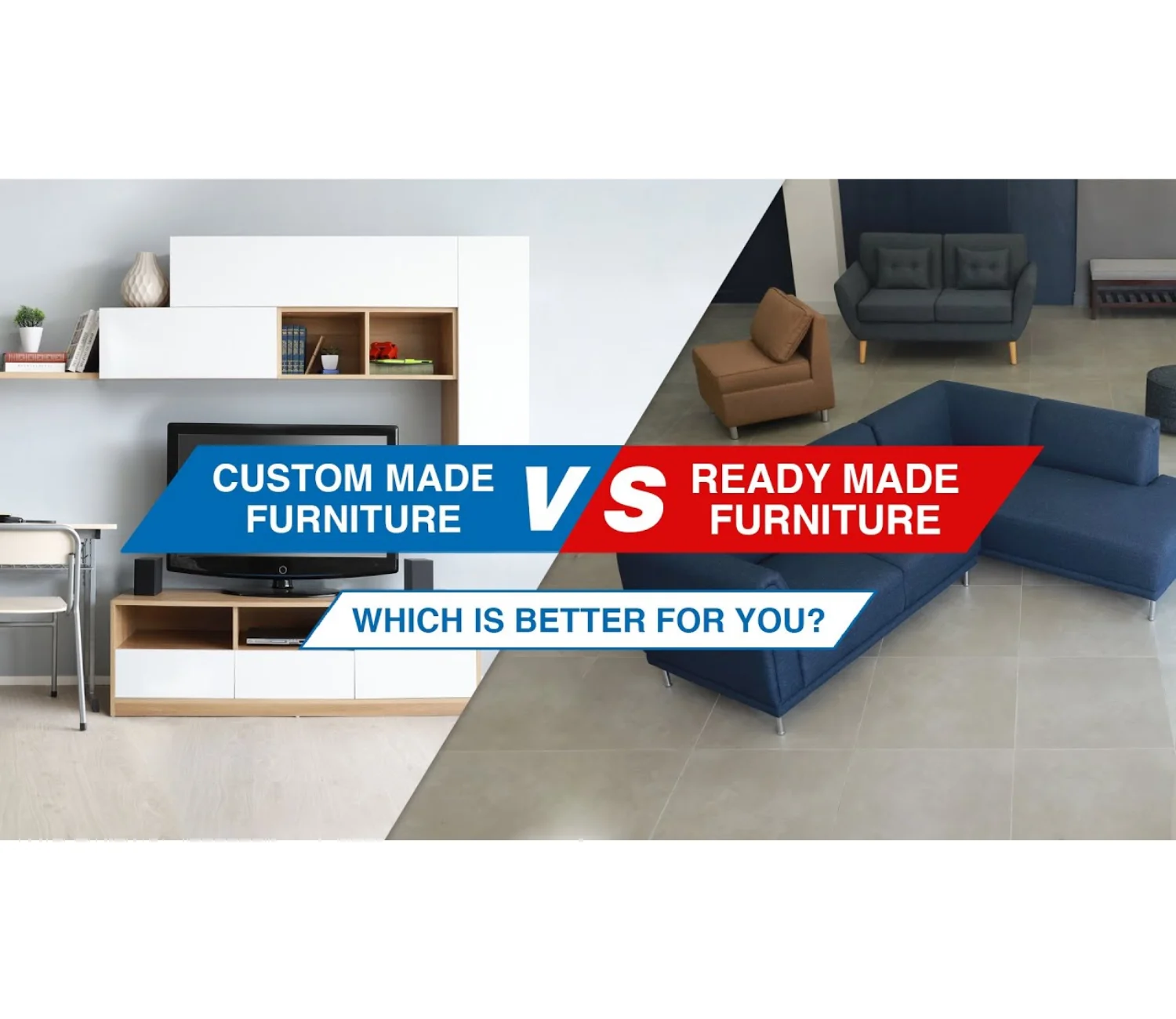
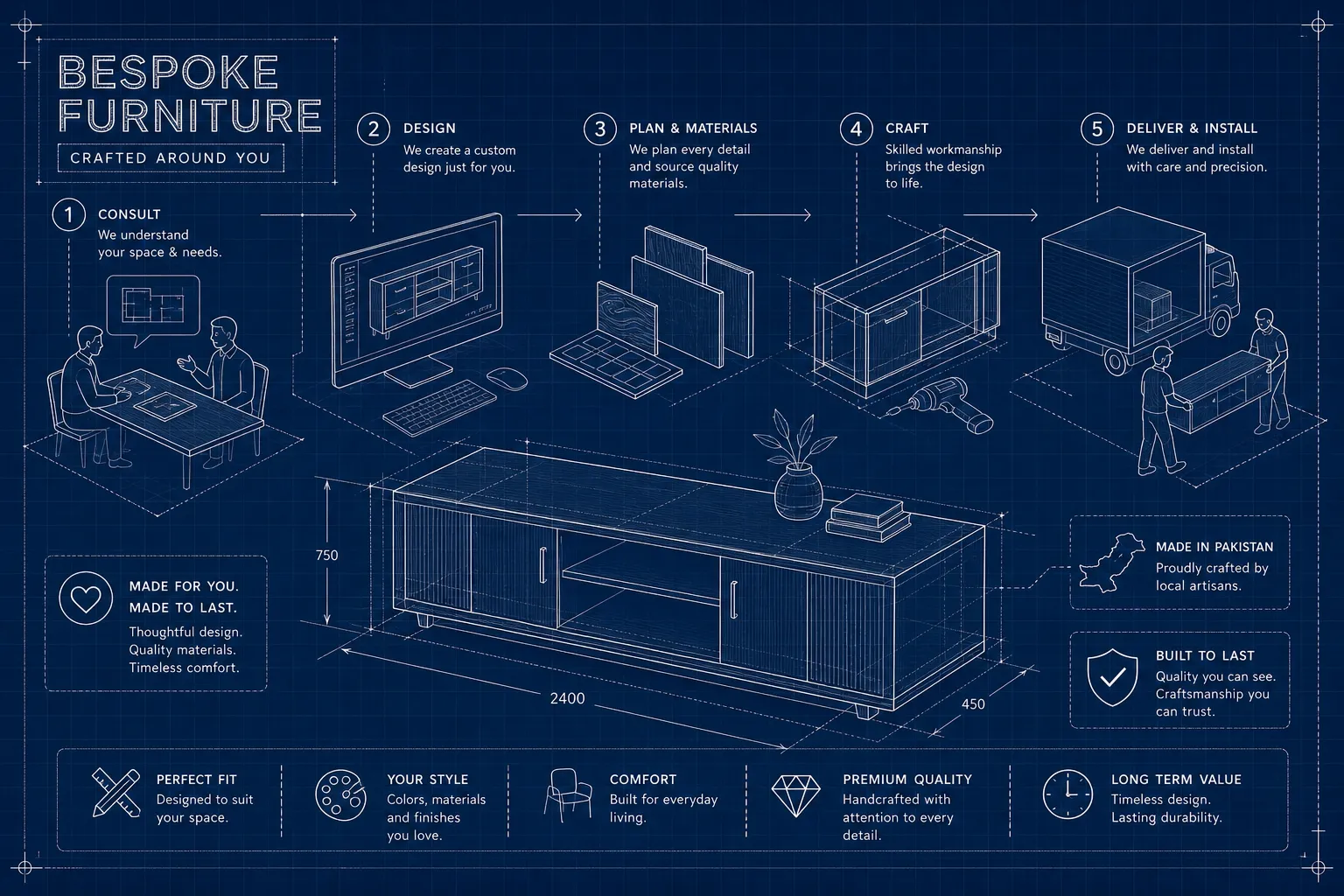
    Ready-made vs. custom furniture: which suits your situation

    Best Furniture Colors for Bedrooms in Pakistan 2026

    Ready-made furniture is faster, select items from established retailers can be available for collection the same day, and generally lower in cost. If your rooms are standard sizes and your taste aligns with what is currently on the showroom floor, it is a perfectly sound choice. Custom or bespoke furniture typically takes between two and six weeks depending on complexity, but it gives you complete control over dimensions, materials, finish, and hardware.

    For new housing society homes where room layouts can be irregular, custom can deliver better value for space, particularly in developments such as DHA, Bahria Town, or Gulberg, though it is always worth getting comparative quotes before committing. Some brands offer both ready-made and bespoke options under one roof, which means you are not forced to choose between speed and quality from the outset.

    Bedroom furniture every new homeowner needs

    The bedroom is where the furnishing journey starts, and the decisions you make here will affect your sleep and your daily routine for years.

    The must-have pieces for a Pakistani bedroom

    The core bedroom set consists of a bed frame with headboard, a quality mattress, a wardrobe, a dressing table, and side tables. Of these, the bed itself is the one piece where compromising carries a real cost. A poor mattress or a structurally weak frame affects your sleep every single night, and the savings rarely justify the long-term toll. Solid wood frames with upholstered headboards in materials like velvet or full-grain leather are not just aesthetically appealing; they are structurally superior to pressed wood alternatives and will last considerably longer.

    For a master bedroom in a standard mid-range home, a queen-size or king-size bed with storage drawers built into the base is the most practical choice. Built-in storage underneath the bed reduces the need for additional furniture and keeps smaller bedrooms from feeling cluttered. Beds with hydraulic lift-up storage systems are particularly popular in Lahore’s growing apartment market for exactly this reason.

    Wardrobe and storage choices for Pakistani bedroom sizes

    Wardrobe selection depends heavily on your room’s wall configuration. Pakistani bedrooms in newer housing societies often have specific wall layouts that suit built-in or modular wardrobes far better than freestanding units. A bespoke wardrobe fitted precisely to your wall dimensions makes far better use of vertical space and creates a clean, tailored finish that off-the-shelf alternatives simply cannot match.

    The three main configurations are hinged door, sliding door, and walk-in. Sliding door wardrobes are the most common choice for smaller rooms because they do not require floor clearance to open. For master bedrooms, three-door hinged units are a popular standard, the benefit here is a balanced mix of hanging space and drawer storage in a format most manufacturers produce well. For walk-in configurations, a bespoke solution fitted by a manufacturer who can work to your exact dimensions is the only sensible approach.

    Lounge and dining room essentials that make a house feel like home

    In a Pakistani home, the lounge and dining room carry more social weight than any other space, these are the rooms guests experience first, and where daily family life plays out most visibly.

    Sofa sets and living room furniture that work for Pakistani homes

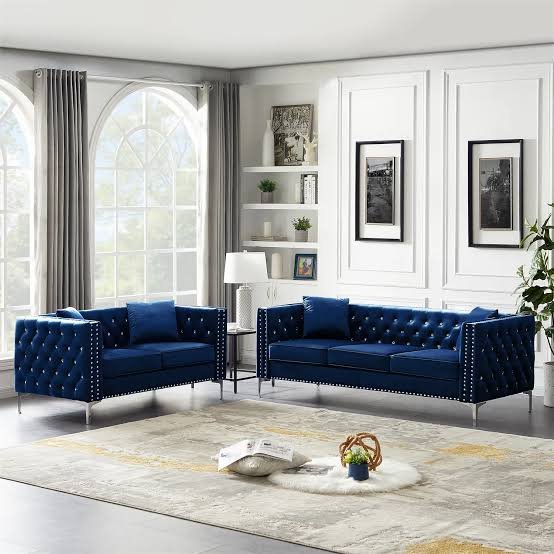
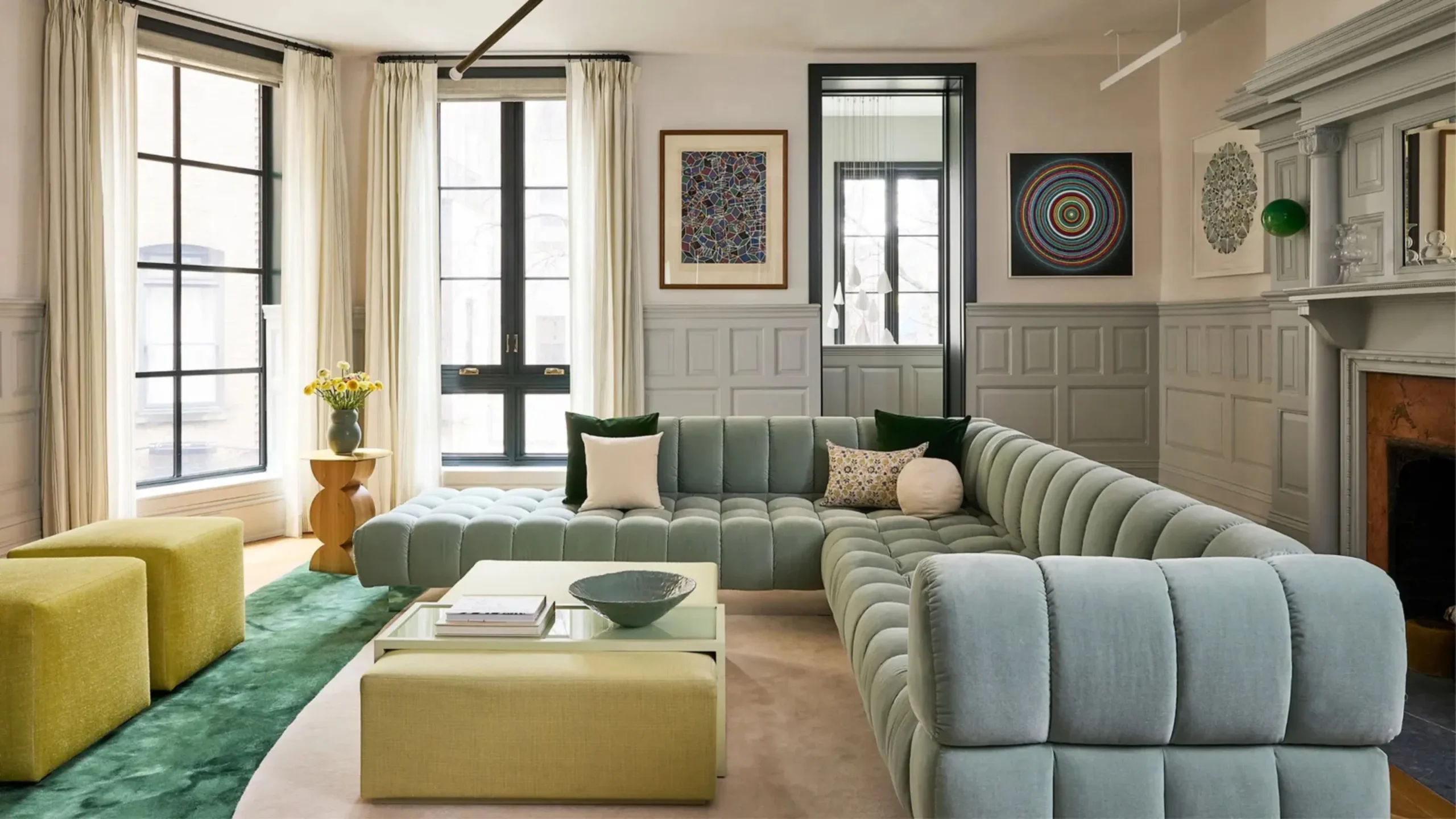
    A quality sofa set is the centrepiece of the lounge, and for Pakistani households buying the best furniture for a new house, seating capacity is the first practical consideration. The minimum comfortable rrangement for most families is a six-seater. The traditional 3+2+1 drawing room configuration remains popular for formal guest areas, while L-shaped sectionals are increasingly favoured in modern open-plan homes in DHA and Bahria Town developments. Both configurations work well; the choice depends on whether your lounge has a formal layout or a more contemporary open feel.

    Upholstery durability matters more than most buyers realise at the point of purchase. Velvet gives a rich, luxurious finish and is popular in Pakistani drawing rooms, though it requires more care and regular cleaning in dusty environments. Full-grain leather is harder-wearing, easier to clean, and develops character with age. Microfiber is the practical choice for family rooms where children are involved. Pair your sofa set with a coffee table, a TV unit, and a side console to complete the room without overcrowding it.

    Dining table choices for families of different sizes

    A six to eight-seater dining table is the standard for most Pakistani households, with an eight-seater being the more comfortable choice when extended family visits are frequent. Material options vary considerably in character: solid wood brings warmth and a traditional feel, marble tops make a premium statement, and tempered glass suits contemporary interiors where you want the space to feel lighter and more open. Rather than treating each option as equally weighted, let your existing lounge furniture guide the choice, buying your lounge and dining pieces from the same brand or design family ensures visual coherence across both rooms without requiring you to second-guess whether the finishes will complement each other.

    Kitchen furniture and the finishing touches that complete a home

    Kitchen furniture is often left to last, but it shapes how functional daily life actually feels. Even if it falls in your second or third furnishing phase, getting the kitchen right is worth doing properly.

    Modular kitchen cabinets and fittings

    For new housing society homes, modular kitchen cabinets are the preferred choice because they install quickly and can be fitted precisely to your kitchen’s dimensions. Ceiling-height upper cabinets maximise storage and eliminate the dust-collecting gap between the top of the cabinet and the ceiling, which is a common frustration in Pakistani kitchens. The most practical material combination for the Pakistani climate is a moisture-resistant HDHMR or plywood carcass paired with high-pressure laminate doors, which handle humidity near sinks and cooking areas far better than standard MDF. Mid-range modular kitchens in Lahore and Karachi typically start from PKR 9,000 to 18,000 per pull-out module, scaling upward for premium finishes and hardware brands such as Blum or Hettich.

    Home décor accessories that tie every room together

    Once the major furniture pieces are in place, the finishing layer is what transforms a furnished house into an actual home. Rugs, lighting, curtains, cushions, and decorative accents all contribute to this, but the single most important rule is to resist buying décor before your furniture is in place. Accessories chosen to complement specific furniture pieces will always work better than décor bought on impulse before the room is defined. Match accessory tones to your dominant furniture material: warm wood tones pair naturally with amber lighting and earth-toned rugs, while marble surfaces call for cooler, cleaner accent colours. If you are drawn to local craft traditions, brass accents, for instance, or geometric patterns rooted in Mughal-era design, these integrate beautifully into both classic and contemporary Pakistani interiors when the underlying furniture palette is settled first.

    Why buying from one trusted source simplifies everything

    Visiting multiple stores, coordinating deliveries from different suppliers, and hoping that everything matches in person is time-consuming and expensive. Mismatches in finish or scale are only visible once the pieces are in your home, by which point returning individual items becomes complicated.

    The case for curated housewarming bundles

    Some furniture brands offer curated housewarming bundles that cover every room, from the bedroom and lounge to the dining area and kitchen, under one roof. The practical benefits are clear: a single point of contact for all your questions, a consistent design language across every piece, and no scheduling conflicts between multiple delivery crews. For new homeowners who do not want to spend weeks coordinating between suppliers, this is a more efficient way to furnish a home. Gourmet Furnishers is one option worth exploring in Lahore, offering both ready-made and bespoke pieces alongside design consultation. Ask any shortlisted brand about factory or showroom visits before delivery, some manufacturers permit this, and the transparency it provides is genuinely reassuring when you are spending at this scale.

    What to look for in warranty and after-sales support

    A furniture purchase at this scale is a meaningful financial decision, and the terms of your warranty matter. Always request a formal manufacturer’s warranty that covers structural defects and craftsmanship, not just a verbal assurance. When comparing furniture brands in Pakistan, look specifically at warranty duration, what is covered, and whether there is a documented return or exchange policy, terms that reputable brands should be willing to share in writing. Ask whether post-delivery support is accessible through a channel that suits you, whether that is WhatsApp, phone, or in-store, the ease of reaching someone after delivery matters as much as the purchase experience itself.

    Your house will feel like home sooner than you think

    Furnishing a new house in Pakistan does not have to be chaotic or exhausting. When you start with a clear prioritisation order, set a realistic budget for your tier, and work through each room methodically, the process becomes manageable rather than overwhelming.

    The best furniture for a new house in Pakistan is not the most expensive option or the most followed brand on social media. It is furniture that fits your rooms properly, suits how you actually live, and comes from a source that stands behind what it sells. Whether you explore curated bundles from a single trusted brand like Gourmet Furnishers or piece together the best furniture options for your new home in Pakistan from several reputable retailers, among them Interwood, Habitt, and Woodland, all of whom offer a range of ready-made and custom options, the principles remain the same: prioritise well, buy for the long term, and insist on documented after-sales support.

    Start with the bedroom. Plan the lounge next. Let each room follow naturally from there, and the empty house will feel like home sooner than you expect.

    FAQs

    What furniture should I buy first for a new house in Pakistan?

    Start with essential furniture such as a bed, sofa set, dining table, wardrobe, and storage units before adding decorative pieces.

    How do I choose the right furniture for each room?

    Consider the room size, functionality, available space, and your interior style to select furniture that is both practical and visually appealing.

    Which type of furniture is best for Pakistani homes?

    Solid wood, engineered wood, and high-quality upholstered furniture are popular choices because they offer durability, comfort, and timeless style.

    How can I furnish a new home on a budget?

    Prioritize essential furniture first, choose multifunctional pieces, compare prices, and invest in quality items that provide long-term value.

    Where can I buy quality furniture for a new house in Pakistan?

    You can find quality furniture from reputable furniture stores, local manufacturers, and trusted online furniture retailers that offer a wide range of designs and materials.

  • New Home in Pakistan? Here’s What Furniture to Buy First

    New Home in Pakistan? Here’s What Furniture to Buy First

    When moving into a new home in Pakistan, start by buying the most essential furniture that supports your daily needs and comfort. A durable bed and mattress should be your first priority, followed by a wardrobe for storage, a comfortable sofa set for the living room, and a dining table if space allows. Next, add practical items like a center table, TV unit, study desk, or office chair based on your lifestyle. Choose high-quality wooden furniture that is durable, easy to maintain, and suits your home’s size and interior style. Instead of purchasing everything at once, invest in essential pieces first and gradually add decorative or luxury furniture as your budget allows, ensuring your new home remains both functional and welcoming.

    The bedroom is where you start, full stop

    You need a functional place to sleep from the very first night in your new home. That alone makes the bedroom your non-negotiable priority. Beyond basic comfort, the bed set defines the scale and proportion of the master bedroom before anything else goes in. Place the bed first, and every other decision in the room follows logically: wardrobe position, side table placement, dresser or dressing table position. Skip it, and you’re arranging furniture around an invisible centrepiece.

    In many Pakistani homes, the master bedroom carries more social weight than people typically account for. It can double as a private sitting area, a nursing room, or a children’s study corner, especially during family gatherings when space is at a premium. This is not just a sleeping space. Getting it right early pays dividends every single day.

    Bedroom first: what furniture to buy for a new house in Pakistan

    Why the bed set is the anchor piece, not just a starting point

    A bed set, frame, headboard, and side tables together, functions as both a visual and spatial anchor for the entire room. Once the bed is placed against the right wall, every other piece arranges itself around it naturally. The wardrobe goes here, the dressing table goes there, the lighting follows. Without the bed as a reference point, you’re making spatial guesses that often result in a room that never quite settles.

    For a standard master bedroom in a housing society like DHA or Bahria Town, a king-size frame works well in most room configurations, though room sizes do vary by sector, so measure before you commit. A queen-size works well in tighter rooms without sacrificing too much floor space. Either way, decide on the bed before you buy anything else in the room.

    Wardrobe and storage: don’t underestimate these on day one

    The wardrobe is the second purchase in the bedroom, not something to defer until later. Without proper storage, clothing and belongings pile up immediately, and the room never achieves the settled, organised feel you’re aiming for. A room with a beautiful bed and no wardrobe still looks unfinished and functions poorly.

    For smaller bedrooms in apartments, floor-to-ceiling wardrobes that use vertical space are significantly more effective than standard units. A three-door built-in wardrobe with internal shelving, hanging rails, and a drawer section handles most families’ storage needs without consuming excessive floor area. If your bedroom has an alcove or a non-standard wall configuration, this is precisely where custom becomes worth considering over ready-made.

    Materials that actually hold up in Pakistan’s climate

    Pakistan’s heat-and-humidity cycle, particularly during monsoon season, is genuinely harsh on furniture. Solid sheesham remains the best choice for longevity because it expands and contracts naturally without permanent warping or swelling. Properly seasoned and finished with a polyurethane coating, a sheesham bed frame will outlast multiple house moves.

    MDF is the material to avoid for structural pieces. It absorbs monsoon humidity, swells permanently, and fails within three to five years under heavy use. For mid-range budgets where solid wood is out of reach, marine-grade plywood with sealed edges and a polyurethane finish is a viable and durable alternative. Whatever you choose, ask specifically about the material before you commit.

    What furniture should I buy first, lounge and dining priorities

    The lounge comes next, and the sofa does most of the work

    The lounge is the primary gathering and guest-reception space in Pakistani households. It carries significant social weight, which means the sofa is not simply a seating choice. It anchors the entire room’s layout, sets the colour direction, and communicates the overall style register of your home to every guest who walks through the door. Get the sofa right early, and every other lounge piece, from the coffee table and side tables to rugs and curtains, can be chosen in relation to it rather than in conflict with it.

    Why the sofa is a structural decision, not just a style one

    The size and placement of the sofa determines traffic flow, conversation distances, and how much wall space remains available for other furniture or décor. A sofa that’s too large for the room closes it off entirely; one that’s too small looks lost and inadequate for guests. Before you fall in love with a particular design, measure your lounge and work out the maximum sofa dimensions that allow comfortable movement around it.

    In most standard Pakistani drawing rooms, a three-to-four seater sofa paired with a complementary side chair is the functional baseline. This arrangement comfortably seats four to six people depending on chair choice, allows for conversation across the room, and leaves enough open floor space that the room doesn’t feel crowded. A corner sectional works well in L-shaped lounges but can feel overwhelming in a square room.

    Coffee table and side storage: the room isn’t finished without them

    A sofa without a coffee table feels incomplete and impractical from day one. It anchors the seating arrangement and serves as the primary surface for everyday use: cups of chai, remote controls, books, and the inevitable pile of things that accumulate in a lived-in lounge. For smaller lounges, a lift-top coffee table with internal storage solves two problems at once.

    Storage ottomans are an equally practical alternative. They provide flexible extra seating when guests arrive, work as a footrest during everyday use, and store blankets, magazines, or children’s toys out of sight. In a compact lounge, an ottoman can provide greater versatility and storage density than a traditional coffee table, particularly useful given how many new homes in Pakistan lean towards the space-saving end of the spectrum.

    The dining area gets put off too often, and it’s a mistake

    Many first-time buyers treat the dining area as a third-tier priority and end up eating from the lounge sofa for months. The practical friction this creates accumulates quickly, particularly in Pakistani households where communal meals are a core daily rhythm and family gatherings happen regularly. The dining table is also the homework surface, the workspace, and the centrepiece of Eid lunches. It earns its place early.

    Choosing the right table size before you fall in love with a design

    The most common dining room mistake is choosing a table based on aesthetics without first matching it to actual family size and room dimensions. A six-seater table placed in a tight dining alcove leaves no room to pull chairs out comfortably, which makes every meal feel cramped. Measure the room, account for at least 90 centimetres of clearance on all sides, then select a table size.

    The practical guide is straightforward: a four-seater works for couples and small families in compact spaces; a six-seater is the Pakistani household standard and fits most medium dining rooms comfortably; an eight-seater is only appropriate if the dining room is genuinely large. For a family of six, the recommended table length is between 160 and 180 centimetres, with a width of 90 to 100 centimetres.

    Chairs vs benches: what suits your space and how you actually eat

    Dining chairs take up more floor space when pulled out, which matters in tighter rooms. Benches tuck neatly under the table when not in use and can seat multiple people without the footprint of individual chairs. For families with young children, or homes where the dining area doubles as a study or craft space, a bench along one side of the table offers flexibility without sacrificing seating capacity.

    This is a practical decision that first-time homeowners rarely think about until they’ve already assembled furniture in the room. Consider how you actually use the space daily, not just how it will look for guests.

    Ready-made or custom: a practical call, not just a budget one

    The common assumption is that ready-made furniture is always faster and cheaper, and custom is a luxury for later. The reality is more nuanced. The right answer depends on timing, room dimensions, and how long you intend to stay in the home.

    Ready-made makes complete sense when you need to be functional within a week. If you’re moving in on a Saturday and need a sofa and dining set by Sunday, ready-made is your only realistic option. Ready-made pieces are also sensible for secondary bedrooms, children’s rooms, or spaces that will change as the family grows. The trade-off is standard sizing, standard materials, and lower long-term durability.

    The calculus shifts when the room has non-standard dimensions or you’re buying for the long term. Custom furniture is worth the wait for the master bedroom wardrobe in a non-standard alcove, a dining table that must fit a specific room configuration, or any piece where exact dimensions and premium materials matter. Lead times in Lahore typically run three to eight weeks for most custom residential pieces, worth factoring into your moving timeline. The cost premium of roughly twenty to fifty percent over ready-made equivalents is offset by better material quality, exact fit, and a significantly longer lifespan. For homeowners who plan to stay put for ten or more years, custom furniture in the key rooms is often the more economical decision over time.

    How to furnish every room without the back-and-forth

    Sourcing bedroom furniture from one supplier, lounge furniture from another, and dining furniture from a third creates a coherence problem that’s easy to underestimate. Finishes don’t quite match, proportions feel slightly off, and the overall look of the home never fully comes together. Achieving a cohesive interior when every room comes from a different source requires time, coordination, and a level of design expertise most people furnishing their first home don’t have yet.

    When one brand carries the full range, from bed sets and wardrobes to sofas, dining tables, and home décor accessories, the finish tones and design language stay consistent throughout the home. This is a design principle worth taking seriously. A home where every room speaks the same visual language feels deliberate and considered, even before a single piece of art goes on the wall.

    Gourmet Furnishers is a Lahore-based luxury furniture manufacturer whose range covers bed sets, wardrobes, sofa sets, dining tables, and kitchen fittings. Their pieces are manufactured in-house using materials that include solid sheesham, walnut, marble, and full-grain leather. You can visit the factory in Lahore before delivery to inspect pieces directly, a level of transparency worth asking about when comparing suppliers. The brand offers a two-year warranty on structural defects and craftsmanship, alongside a thirty-day return policy. For further details on specific products and current terms, it’s worth reaching out to them directly.

    For new homeowners in DHA, Bahria Town, or Gulberg who want quality furniture without the coordination overhead, working with a single full-range supplier is the most straightforward route from an empty house to a fully furnished home.

    Start with a sequence, not a shopping list

    So, what furniture should you buy first for a new house in Pakistan? The priority logic is simple once you see it clearly. Bedroom first, because you live there from day one and the bed set shapes every subsequent decision in the room. Lounge second, because it sets the social register of your home and the sofa is the structural starting point for the entire space. Dining area third, because family rhythm and daily life depend on it more than most first-time buyers realise until the sofa has doubled as their dining table for four weeks running.

    Settle your material and budget decisions before you walk into any showroom. Know whether you’re choosing solid wood or marine-grade plywood, know your maximum dimensions for each room, and know which pieces are worth the wait for custom and which can be ready-made without compromise. That preparation alone will save you from the two most common mistakes: buying the wrong thing quickly, or buying nothing because the decisions feel too large.

    If you want to skip the back-and-forth entirely, Gourmet Furnishers’ housewarming bundles are designed for exactly this moment. You can browse their range online, book a factory visit, or simply reach out via WhatsApp with your room dimensions and budget, they’ll take it from there.

  • Best Furniture Showrooms in Lahore: A Smart Buyer’s Guide

    Best Furniture Showrooms in Lahore: A Smart Buyer’s Guide

    The best furniture showrooms in Lahore offer a wide variety of styles, from modern and minimalist designs to classic solid wood furniture, making it easier for buyers to find pieces that match their budget and home décor. A smart buyer should compare furniture quality, materials, craftsmanship, customization options, warranty, delivery services, and customer reviews before making a purchase. Visiting multiple showrooms allows you to inspect finishes, test comfort, and compare prices, while choosing a trusted furniture brand ensures long-lasting value and reliable after-sales support. Whether you’re furnishing a new home or upgrading a single room, selecting a showroom that offers durable materials, transparent pricing, and professional customer service will help you make a confident and worthwhile investment.

    How to evaluate a furniture showroom before you spend a single rupee

    Furniture Showrooms in Lahore

    Most buyers walk into a showroom, fall in love with how something looks under showroom lighting, and make a decision based almost entirely on aesthetics. That is how you end up with furniture that disappoints you within a year. The smarter approach is to treat your visit like a quiet inspection, because a well-made piece of furniture tells you everything you need to know if you know where to look.

    Material quality: what to look and touch for

    Start with weight. Solid wood is significantly heavier than engineered board, and you can feel the difference immediately when you gently lift a corner of a table or a drawer. On a genuine solid oak or walnut piece, the grain will show natural variation across the surface, no two sections will look identical. If a piece labelled “walnut” has a perfectly uniform, almost photographic grain, it is likely a printed veneer over MDF rather than solid timber. Treat this as a prompt to ask the salesperson for written specifications before proceeding.

    For upholstery, run your fingers along the stitching lines. On quality sofas, the kind you find at the better furniture shops in Lahore, the stitching is tight, evenly spaced, and does not pucker at the corners. Full-grain leather has a slightly uneven, natural surface texture. Bonded leather feels smoother and more plastic-like, and tends to delaminate or peel sooner than full-grain alternatives. On marble or brass accents, look for consistent veining and finish across the slab and minimal visible seams, which are the clearest indicators of quality cutting and fitting.

    Craftsmanship details that reveal the real story

    Pull out every drawer. A well-made drawer glides on soft-close runners and sits flush when closed. Cheap sliders stick, rattle and show a gap at the top. Open cabinet doors and check the alignment: doors that hang slightly off or close with a clunk indicate rushed assembly or poor fitting. Then check the inside surfaces of cabinets and the underside of sofa frames. A manufacturer confident in its craftsmanship finishes what customers rarely see. If those hidden surfaces are rough, unpainted or badly assembled, that is the true quality of the piece.

    Any showroom that is proud of its product will welcome a close inspection. Ask to open cabinet doors, request to see the underside of frames and ask for written specifications on materials. If a salesperson becomes evasive when you crouch down to look at a sofa frame or reach for a wardrobe door, take that as a useful data point. It signals how much confidence the brand actually has in what it is selling you.

    Best furniture showrooms in Lahore: where they cluster by area

    Best Furniture Showrooms in Lahore

    Lahore’s furniture showrooms are grouped by area in a pattern that makes planning your visits straightforward once you understand it.

    Gulberg and DHA: where the flagship showrooms are

    This corridor is Lahore’s premium furniture belt. Expect finished showrooms with in-house designers, clearly presented product ranges and price tags that reflect genuine material quality. Royal Thrones (45-D1, MM Alam Road, Gulberg III, +92 300 844 5616) is one of the anchor names here, with a solid reputation for after-sales support. Interwood’s DHA branch (211-Y Block, DHA Phase 3, 042-35692551) covers the full-home solution at the quality end. Kalamkaar and Gourmet Furnishers round out this area as the destinations for bespoke and handcrafted luxury. Style in this corridor leans modern-classic, minimalist luxury and custom design work.

    Johar Town and Bahria Town: mid-range to high-end variety

    This cluster suits buyers who want variety and competitive prices without sacrificing too much on finish. Key options to visit include:

    • Mohkam Furnishers , 599-H3, Johar Town Main Boulevard, opposite Expo Centre, +92 42 35316661. Operating since 1974, with a reliable reputation for quality detailing.
    • MJ Furniture , Plot 37-A, Johar Town, 042-35447472. Broad selection across price points.
    • Furniture Galleria , Shop 269, Block H, opposite Emporium Mall Gate 1, +92 321 4447160. Wide range from mid-market to higher-end pieces.
    • Nevi Home (Bahria Town), 46-B Commercial, Sector C, 03000-733000. Specialises in modern Turkish-influenced furniture and carries a 10-year warranty on its luxury line, which is worth noting.

    Garden Town and Defence Road: value-focused and high-volume

    This belt caters to buyers seeking a broader price range with larger physical inventories. Walk-in comparison shopping is easier here because furniture stores in Lahore’s Garden Town and Defence Road corridor are densely packed along Ferozepur Road. Interwood’s Garden Town branch (7, Babar Block, New Garden Town, 042-35831800) anchors the quality end of this cluster. If you want to cover a lot of ground in one trip and compare multiple styles and price points side by side, this is the area to start.

    Gourmet Furnishers: the benchmark worth knowing about

    Before you compare showrooms in Lahore, it helps to understand what genuinely best-in-class looks like. Gourmet Furnishers is not just a showroom; it is a factory-backed manufacturer, and that distinction shapes the entire buying experience.

    Why manufacturing transparency matters when choosing a furniture showroom in Lahore

    Most furniture showrooms in Lahore are retail fronts. They display finished pieces, take your order and hand it off to a third-party supplier. You have no visibility into what actually happens between payment and delivery. Factory-backed manufacturers like Gourmet Furnishers operate differently: rather than sourcing from unnamed third parties, production is handled in-house, which means you can ask directly where the furniture is made, what materials are being used and whether you can verify the finish before delivery arrives at your door. That level of transparency is rare in Pakistan’s furniture market, and it is a standard worth pressing for at every showroom you visit, regardless of whether you end up buying from Gourmet Furnishers or elsewhere.

    Bespoke design services and warranty terms as a quality signal

    Gourmet Furnishers offers fully custom furniture built to your interior: dimensions and material selection from solid oak, walnut, marble, brass, velvet and full-grain leather, all tailored to your space. When evaluating any premium showroom, the questions to ask are: what does the warranty cover, how long does it last, and what does the return process actually look like? A showroom that cannot answer these questions clearly leaves you carrying all the post-purchase risk alone. Confirm the specific warranty and return terms with each showroom you visit, including Gourmet Furnishers, and get them in writing before placing an order.

    Price brackets: what your budget actually gets you

    Understanding price tiers before you visit a sofa showroom in Lahore or any other furniture outlet saves you the discomfort of falling in love with something well outside your budget.

    Budget and mid-range tiers (₨100,000 to ₨450,000)

    A full three-room set in the budget bracket, covering a sofa set, bedroom set and dining set, comes in between ₨100,000 and ₨180,000. At this level, expect engineered board construction, entry-level upholstery and limited customisation. Mid-range stretches from ₨250,000 to ₨450,000: here you start seeing solid wood frames, better fabric grades and more design options. Showrooms in Johar Town and Garden Town are the best hunting ground at this price point, where competitive pricing and variety make comparison shopping straightforward.

    Luxury tier (₨600,000 and above): what the premium actually buys

    At the luxury end, a three-piece sofa set alone starts around ₨350,000. What shifts at this level is not just the material: it is craftsmanship consistency, finishing on surfaces no one will see, meaningful after-sales support and genuine customisation depth. Bedroom sets at premium brands start around ₨200,000 and dining sets from ₨100,000 upward. This is where bespoke design services, factory-backed production and manufacturer warranties become standard expectations rather than pleasant surprises. Gulberg and DHA showrooms dominate this bracket, and the price premium reflects a real difference in what you take home.

    Customisation, delivery and after-sales: the exact questions to ask

    Most post-purchase regret in Lahore’s furniture market comes from assumptions buyers made that turned out to be wrong. The fix is straightforward: ask the right questions before you leave the showroom.

    Custom options and lead times

    Ask whether the showroom manufactures in-house or sources from third-party factories. This directly affects how much flexibility they have on dimensions, materials and finishes. Ask for the lead time on custom or made-to-order pieces upfront. Based on lead times quoted by showrooms in this guide, bespoke furniture in Lahore typically takes three to twelve weeks depending on complexity. Simpler pieces like basic cabinets can be ready in three to four weeks; intricate carved work or fully fitted wardrobes can take eight to twelve weeks or more. Showrooms like Interwood, Kalamkaar and Mohkam Furnishers explicitly offer custom builds, but always confirm whether your specific requirement falls within their standard scope or requires a separate quote.

    Delivery, installation and return policy

    Confirm whether delivery and installation are included in the price or charged separately, this is one of the most common hidden costs in Lahore’s furniture market. Ask what happens if a piece arrives damaged: a confident showroom will have a documented process for this, and you should hear it described clearly and without hesitation. For damage during transit specifically, most showrooms require you to report it within 24 hours of delivery. Return windows across Lahore’s furniture shops typically range from 7 to 30 days depending on the brand; at premium showrooms, press for the longer end of that range and at minimum a one-year structural warranty. Get all of this in writing before you place an order.

    How to narrow it down and plan your visits

    With the framework above in place, you are ready to convert information into action. The goal is to visit two or three showrooms with intention, not wander through eight and come home more confused than when you started.

    Matching your style and budget to the right area

    Know your budget tier before you leave the house. Then identify your dominant style preference: warm minimalist with natural materials, transitional modern-classic, or something bolder with carved details and rich upholstery. Map those preferences to the geographic clusters in this guide. A buyer with a mid-range budget and an eye for modern Turkish-influenced pieces should head to Nevi Home in Bahria Town as a first stop. A buyer wanting full bespoke control over materials and dimensions should start in Gulberg, where Gourmet Furnishers and Kalamkaar both offer that level of service.

    Making the most of each visit

    Limiting yourself to three showrooms per day is a practical way to keep comparisons clear and avoid the fatigue that comes from processing too many options at once. Bring your room measurements, a photo of your existing interiors and the checklist of questions from the section above. Photograph every piece that interests you and ask for written quotes that specify the material, dimensions, lead time, delivery terms and warranty coverage, research into post-purchase disputes consistently shows that missing written agreements are the most common source of buyer regret. The showroom that handles these requests smoothly and without making you feel awkward is almost always the one that will handle your order the same way. A polished showroom floor means nothing if the team cannot answer basic questions about what they are actually selling you.

    You now have a framework, not just a list

    The best furniture showrooms in Lahore are not the ones with the largest floor space or the most aggressive marketing. They are the ones that are transparent about their materials, clear on their after-sales policies and willing to let you inspect their work up close. Gourmet Furnishers exemplifies this approach through its factory-backed manufacturing model, in-house bespoke design service and clear warranty terms, and the questions those policies prompt are worth putting to every showroom you visit, regardless of where you ultimately buy.

    Use the price tiers and area clusters in this guide to shortlist two or three showrooms that match your budget and style. Then walk in with your measurements, your questions and your inspection checklist. The showroom that performs well on all three is the one worth trusting with your home.

    A good next step is to pick one showroom from this guide and book a visit this week. If you want to start with a benchmark for what factory-backed manufacturing looks like in practice, Gourmet Furnishers is reachable on WhatsApp for appointments and consultations. Visit the showroom, ask directly about their production process and warranty terms, and you will quickly understand why manufacturing transparency matters so much when choosing the best furniture showroom in Lahore for your home.

    FAQs

    What should I check before buying furniture from a showroom in Lahore?

    Check the material quality, construction strength, finish, warranty, delivery service, and customer reviews before making a purchase.

    Are custom furniture options available in Lahore showrooms?

    Yes, many premium furniture showrooms in Lahore offer customization in size, fabric, color, wood type, and design.

    How can I compare prices between furniture showrooms?

    Visit multiple showrooms, compare similar products, ask for written quotations, and check whether delivery and installation are included.

    Is solid wood furniture better than engineered wood furniture?

    Solid wood furniture is generally more durable and long-lasting, while engineered wood is usually more affordable and lighter in weight.

    Do furniture showrooms in Lahore provide warranties?

    Most reputable showrooms provide warranties on structure, wood, and hardware, but the coverage period and terms can vary by brand.

  • What Customers Say About Gourmet Furnishers Pakistan

    What Customers Say About Gourmet Furnishers Pakistan

    Customers say that Gourmet Furnishers Pakistan stands out for its high-quality craftsmanship, durable solid wood furniture, elegant custom designs, and professional customer service. Many buyers appreciate the attention to detail, timely communication, and furniture that matches their expectations in terms of style, comfort, and durability. Customers also value the ability to customize furniture according to their space and preferences, making Gourmet Furnishers a trusted choice for homeowners looking for premium, long-lasting furniture in Pakistan.

    What customers say about Gourmet Furnishers Pakistan: craftsmanship and materials

    Gourmet Furnishers Pakistan

    The feedback we receive most consistently, across every customer type, comes back to the same two things: how the furniture feels the moment it arrives, and how it holds up once life happens around it. These are not the same compliment, and both matter.

    The materials customers keep talking about

    Solid oak bed frames, full-grain leather sofas, and marble-topped dining tables draw the most comments. Customers who have previously bought from mass-market alternatives describe the difference in physical terms: the weight of a solid oak piece, the cool density of real marble, and the grain and suppleness of

    full-grain leather compared to bonded alternatives. These are examples from our higher-specification lines, and the contrast with mass-market products is something buyers notice immediately. A customer in Gulberg who had purchased a mid-range sofa previously described placing her Gourmet Furnishers leather sofa in the same room as “immediately embarrassing the old one.” That kind of comparison lands differently than any product description we could write.

    Pakistani buyers are discerning. They know what compromise feels like, because many have experienced

    1. When they encounter the real thing, solid walnut joinery, brass hardware, hand-selected timber, they notice. A substantial share of our referrals come directly from customers recommending us to family and friends after that recognition.

    How craftsmanship holds up after months of use

    Delivery-day impressions are easy to manufacture. Durability is not. At the six-month and twelve-month marks, the Gourmet Furnishers reviews we receive from customers focus on joinery that has not loosened, upholstery that has retained its shape, and finishes that have resisted the daily wear of a busy family home. One customer in DHA Phase 5 sent us a photograph fourteen months after delivery, noting that her dining set looked identical to the day it arrived despite regular use. That is the standard we build to.

    The factory visit: what customers find when they walk in

    One of the most distinctive elements of buying from Gourmet Furnishers is the open factory model. Customers can visit our Lahore facility before their furniture is built or delivered, a stated part of our buying process that we actively encourage. In a market where most buyers cannot see what they are purchasing until it arrives at their door, this matters considerably.

    Seeing the process in person

    A typical factory visit starts with the material store, where customers inspect actual wood grains, hardware finishes, and upholstery samples rather than catalogue photographs. From there, they walk through the workshop and watch craftsmen at work. A newlywed couple from Islamabad drove to Lahore specifically to visit before finalising their Wedded Essentials order. They arrived uncertain about a walnut finish and left having upgraded two pieces after seeing the material in person. They also confirmed their delivery timeline directly with the production team, which removed the anxiety of waiting on a large purchase.

    The shift customers describe is consistent: genuine apprehension about spending a significant sum gives way to confidence that can only come from having seen the thing for yourself.

    What questions buyers ask on the factory floor

    Factory visit conversations tend to cover wood sourcing and seasoning, joinery methods for bed frames and dining chairs, the finishing treatments applied to different timber types, and realistic lead times for bespoke orders. These are exactly the right questions to ask, and we encourage them. A brand with nothing to hide welcomes scrutiny. Customers leave better informed and more confident about what they have bought, which makes the entire ownership experience more settled.

    The bespoke design experience through customer eyes

    Custom furniture is a commitment that carries genuine uncertainty. Customers approach it with excitement about the result and nervousness about the process. What does the journey actually feel like from the inside?

    From concept to finished piece: a real project story

    A customer in Karachi needed a wardrobe fitted to an awkward alcove in a DHA apartment, a recess 2.3 metres wide and 1.1 metres deep, with an angled ceiling on one side. No off-the-shelf piece would fit. The process began with a WhatsApp consultation where she shared photographs and dimensions, and our design team produced sketches within two days, followed by a detailed 3D rendering for approval.

    She requested one modification to the internal shelving layout. The revised design was confirmed within twenty-four hours. Material selection, a matte walnut veneer with brushed brass handles, was finalised via WhatsApp with sample photographs. The completed wardrobe was delivered and installed five weeks after the initial conversation, fitting the alcove precisely. These timelines reflect our standard bespoke process; individual projects may vary depending on complexity and production scheduling.

    What customers say about the design consultation process

    The concern most buyers carry into a bespoke order is straightforward: will the finished piece actually look like what I approved? Customer feedback consistently indicates that the accuracy between confirmed design and delivered piece is high. Where small variations occur, such as a natural timber grain appearing differently under home lighting than in a photograph, we discuss these openly during the design stage so there are no surprises. The consultation process is handled via WhatsApp, which suits how most customers in Pakistan prefer to communicate: direct, responsive, and documented in writing throughout the project.

    What customers say about Gourmet Furnishers Pakistan: after-sales service and the warranty

    Customers generally praise Gourmet Furnishers Pakistan for its professional after-sales support, helpful staff, and willingness to resolve customer concerns even after delivery. Many verified buyers mention responsive service, factory visits before delivery, and cooperative assistance, while the company’s official policies include warranty coverage for solid wood structures, paint and polish, and structural joints, along with a clear warranty claim process requiring proof of purchase. However, some independent customer reviews report delays in warranty claim handling, delivery, and after-sales responses, indicating that service quality can vary by case. Overall, most customers appreciate the product quality and warranty coverage, but buyers should keep their purchase receipt and confirm warranty terms and delivery timelines before ordering.

    What the warranty actually covers, according to customers who used it

    At the eight-month mark, a customer in Johar Town contacted us about a dining chair joint that had developed a slight flex. She messaged via WhatsApp, described the issue with a short video, and received a response the same day. An appointment was scheduled, the chair was collected, the joint was reinforced, and it was returned within a week. A separate customer raised a leather upholstery concern at fourteen months, noting a seam showing minor stress near an armrest. The repair was completed under warranty with no charge. These are not exceptional outcomes, they are the standard.

    The 30-day return experience

    The fear most buyers have around return policies is simple: will the brand actually honour it when it matters? Our thirty-day return and exchange policy, the terms of which are confirmed in writing before purchase, exists to give customers a genuine exit if a piece does not work in their space. One homeowner in Bahria Town Lahore exchanged a coffee table for a different finish within the policy window. The exchange was arranged via WhatsApp, collection and delivery were coordinated, and the replacement arrived within the agreed timeframe. No pressure, no complications.

    Home transformations across Lahore, Karachi, and Islamabad

    Furniture does not exist in isolation. What it does to a home when it is all in place, the way a room shifts from functional to genuinely welcoming, is the real measure of whether a purchase was worth making.

    A Lahore family’s full home project in Bahria Town

    A family in Bahria Town Lahore furnished five rooms over an eight-week period: a king bed set with matching wardrobes, a six-seater dining room set in solid oak, a sofa suite for the formal sitting room, and a custom kitchen. The coordination was managed through a single WhatsApp contact, with deliveries phased to match their move-in timeline. Once everything was in place, the feedback came simply: “It finally feels like a proper home.” That phrase carries more weight than a star rating. It means the furniture did what furniture is supposed to do, make a space feel whole.

    A newlywed couple in Islamabad and an overseas buyer’s story

    A couple in Islamabad furnished their first home using our Wedded Essentials collection. They described the experience of choosing from a curated bundle as removing the decision fatigue of starting from scratch, everything coordinated without requiring them to develop an interior design vocabulary overnight. The result was a cohesive home they were proud to show guests within weeks of their wedding.

    Separately, an overseas Pakistani based in the UK furnished a house in Karachi entirely via WhatsApp over a six-week period, relying on video walkthroughs, detailed photographs of materials, and regular production updates. His local family member coordinated delivery and installation. He described the process as more straightforward than expected, noting that the communication was consistent and the delivered pieces matched what had been discussed and approved remotely.

    What to check before you place your order

    Informed buyers do a few specific things before committing. Look for Gourmet Furnishers reviews independently: check our Google profile, search for us on social media, and look for customer photographs rather than brand photographs. Real homes photographed by real customers tell you more than any staged campaign image. You can also find Gourmet Furnishers testimonials shared directly on our Instagram, where customers post images of their delivered pieces in situ.

    During a WhatsApp consultation, ask about lead times for your specific order, request a sample of the material you are considering, and confirm what the warranty covers in writing before you pay. These are not difficult questions, and a brand worth buying from will answer all of them clearly.

    Book a factory visit. It costs nothing, takes an afternoon, and removes the uncertainty that comes with any significant purchase. You will leave knowing exactly what you are buying, from whom, and why. That confidence is worth more than any discount.

    What the customer experience tells you about a brand

    We do not ask customers to take our word for anything. The factory is open, the warranty is in writing, and the WhatsApp line is active. Every one of those elements exists because we believe the Gourmet Furnishers delivery and service experience should hold up under scrutiny, not because of polished messaging, but because of what actually happens from the first consultation to the moment the furniture is in your home.

    What customers say about Gourmet Furnishers Pakistan is consistent across cities and customer types: quality that holds up, service that respects the investment, and homes that feel genuinely different once the right furniture is in them. That consistency is what we work toward with every order.

    If you are considering a purchase, the best next step is a conversation. Send us a message on WhatsApp, describe what you are working with, and ask every question you have. Or book a factory visit and see it for yourself. The furniture will still be standing long after the conversation is over, and that is exactly how it should be.

    FAQs

    What do customers like most about Gourmet Furnishers Pakistan?

    Customers often appreciate the quality craftsmanship, durable materials, stylish designs, and customization options.

    Does Gourmet Furnishers offer custom furniture?

    Yes, customers can customize furniture dimensions, materials, finishes, and designs to suit their needs.

    Is the furniture made with quality wood?

    Gourmet Furnishers focuses on high-quality materials and skilled craftsmanship to produce durable furniture.

    Are customers satisfied with the buying experience?

    Many customers value the professional service, clear communication, and support provided throughout the purchase process.

    Why do customers recommend Gourmet Furnishers Pakistan?

    Customers recommend the brand for its premium furniture, attention to detail, reliable quality, and personalized solutions for homes and offices.

  • Custom vs Ready-Made Furniture: What’s Worth It in Pakistan?

    Custom vs Ready-Made Furniture: What’s Worth It in Pakistan?

    In Pakistan, custom furniture is worth it if you want personalized designs, exact sizing, premium materials, and long-term durability, making it ideal for homeowners with specific style or space requirements. Ready-made furniture is a better choice if you need an affordable, quick, and convenient solution, as it is readily available and usually costs less. If your budget allows and you value quality, customization, and lasting investment, custom furniture offers better long-term value, while ready-made furniture is best for those prioritizing lower prices and immediate availability. 

    Why standard sizes rarely fit Pakistani homes

    The mismatch problem in most showrooms

    Most ready-made furniture is designed around standardised international dimensions. Pakistani homes, particularly in housing societies like DHA and Bahria Town, frequently have irregular room proportions, low ceiling heights, or awkward alcoves that standard pieces cannot fill cleanly. The result is familiar to many homeowners: a wardrobe noticeably shorter than the ceiling, a sofa that crowds the room, or a dining set that only works if the chairs are tucked in permanently.

    This is not a minor aesthetic inconvenience. Wasted space in a bedroom, or a dining room too cramped to seat the full family, changes how a room functions every single day. Showrooms are designed to make furniture look good in neutral, well-proportioned display spaces. Your home is almost certainly neither neutral nor perfectly proportioned.

    How made-to-order furniture is designed around your actual room, and why it matters

    With custom-made furniture in Pakistan, measurements are taken on-site before production begins. A wardrobe can be built floor to ceiling, using every centimetre of vertical space that a standard piece would leave empty. A sofa can follow the exact footprint of your lounge without pushing into traffic flow. A dining set can be scaled for a family of eight without dominating a medium-sized room.

    This precision is especially critical in kitchen and wardrobe design, two areas where the benefits of custom furniture vs ready-made in Pakistan become most obvious. Even small depth discrepancies of several centimetres can cause functional problems that no amount of styling can fix: drawers that cannot open fully, countertop overhangs that catch on passing traffic, and storage that looks full but wastes the wall behind it. Fit is a functional issue, not a luxury one.

    The material gap you cannot see from the showroom floor

    What goes into most ready-made pieces

    The majority of ready-made furniture sold across Pakistan is built on MDF, particle board, or low-grade plywood. These materials look entirely acceptable under lacquer or a laminate veneer, which is precisely the problem. You are buying based on surface finish, not structure. Standard MDF can experience permanent thickness swelling of 1, 3 mm in humidity above 80 per cent, which is exactly the condition your furniture faces during Lahore’s monsoon months from July through September.

    Particle board joints loosen, surfaces bubble, and drawer runners jam within a few seasons. In our experience across hundreds of Lahore homes, MDFfurniture typically shows structural deterioration within three to seven years, visible and unfixable. By that point, the furniture that looked like a sensible purchase has already begun to fail.

    Why material choice is the single biggest advantage of going custom

    Custom furniture lets you specify the corematerial before production starts. Sheesham, Pakistan’s most durable native hardwood, has a natural density that resists termites, warping, and moisture. In Pakistan’s climate, a well-built Sheesham piece regularly lasts 20 to 30 years. Walnut, solid oak, and full-grain leather are premium alternatives for homeowners who want both longevity and a specific aesthetic character.

    This is where transparency becomes a genuine advantage. At Gourmet Furnishers, customers physically inspect the Sheesham planks, walnut veneers, and brass hardware before the build begins. You can see the grain, feel the weight, and confirm the species before production starts. That level of material transparency simply does not exist when you are buying from a showroom floor model with a laminate finish and no visible interior.

    Which one holds up in Pakistan’s climate, custom furniture vs ready-made compared

    Custom vs Ready-Made Furniture

    How ready-made furniture ages here

    Ready-made pieces built on MDF or particle board typically show structural deterioration within three to seven years in Pakistan’s climate, with the monsoon season accelerating joint failure and surface damage. After five years, most mass-produced sofas, wardrobes, and dining sets exhibit wear that is structural rather than merely cosmetic: drawers that no longer close properly, panels that have swollen and separated at the edges, and frames that flex under load.

    Resale value reflects this reality. In the Pakistani second-hand market, mass-produced furniture typically fetches 10 to 20 per cent of its original purchase price after five years of use. Much of that depreciation is not down to aesthetic preference, it is visible structural deterioration that any buyer can spot on inspection.

    Durability of solid wood with quality joinery

    Custom furniture built from solid Sheesham or walnut, joined with mortise-and-tenon or dovetail techniques, regularly lasts 20 to 30 years. The joinery method matters as much as the wood species. Mechanical joints hold under sustained load and monsoon humidity where glue and screws eventually give way. A mortise-and-tenon joint in Sheesham does not loosen when the air turns damp in August. A particle board joint held together with adhesive often does.

    Custom pieces also carry more meaningful warranties. Gourmet Furnishers backs all furniture with a two-yearmanufacturer’swarranty covering structural defects and craftsmanship, whereas most local ready-made retailers offer six months on wooden pieces, with significant exclusions for anything humidity-related. That gap in warranty commitment reflects a real gap in build confidence.

    The real cost when you run the numbers

    Upfront savings vs replacement cycles

    Ready-made furniture costs less on day one. A standard wooden bed from a Lahore showroom might run PKR 60,000 to 90,000, while a comparable custom piece in solid Sheesham starts around PKR 120,000 to 180,000. That gap is real, and it matters for homeowners working within a defined budget.

    The comparison shifts when you factor in replacementcycles. If a ready-made piece needs replacing every five to seven years, the ten-year cost of ownership for two ready-made purchases often exceeds the cost of one well-built custom piece. For a complete three-bedroom home, ready-made furnishing in Lahore typically runs PKR 1.2 million to 2.5 million; custom runs PKR 2.8 million to 5.5 million. Over a decade with one ready-made replacement cycle factored in, the gap narrows considerably. Meanwhile, the custom piece is still standing.

    Where custom furniture earns its price back

    Custom pieces retain their value because they are builttolast and built to fit. A well-constructed Sheesham wardrobe holds its structure for decades and fits the room it was made for. Market observations suggest that solid wood custom furniture often commands better prices in second-hand markets than mass-produced equivalents, because buyers can assess the difference in quality when they inspect the piece in person, though platform-specific data remain limited.

    For homeowners furnishing a new house in a premium housing society, custom furniture can also contribute to the perceived value of the property itself. A kitchen fitted with quality custom cabinetry, solid joinery, and durable hardware is a genuine asset. Lower-quality particle board cabinetry from a showroom is considerably less likely to add comparable value.

    Lead times, warranties, and what to plan for

    Delivery timelines for each option

    Ready-made furniture can be delivered within days, sometimes the same week. That speed is a genuine advantage when you need to move into a home quickly or furnish a room in a hurry. Custom wardrobes, kitchens, and bedroom suites in Pakistan require patience: standard orders take three to six weeks, complex or carved pieces take eight weeks or more, and premium handmade work occasionally runs to three months. This is the most legitimate reason to choose ready-made, and it deserves an honest acknowledgement.

    How to plan around a custom build

    The lead time concern is manageable with forward planning. New homeowners and couples setting up their first home typically have a move-in date several months out, enough runway for a full custom order. The key is to initiate measurements and material selections early, ideally as soon as a possession date is confirmed. Reputable manufacturers will provide a specific production timeline on order confirmation; always request this in writing before production begins.

    The co-design visit also helps accelerate the process. When design decisions are resolved upfront during a factory consultation, mid-build changes become rare. Gourmet Furnishers schedules factory visits before any production begins, which means customers leave the session with confirmed dimensions, selected materials, and a fixed timeline. Appointments can be arranged via WhatsApp, and many manufacturers can complete an initial consultation in a single afternoon depending on how prepared you are with your measurements and preferences.

    What are the benefits of custom furniture vs ready-made in Pakistan, how to decide

    When ready-made is the sensible choice

    Ready-made furniture makes sense for rooms with standard dimensions, for temporary living situations, for budget-constrained phases of furnishing, or when a piece is functionally simple: a side table, a basic bookshelf, or a utility item that does not define how a room feels. Not every room in a home needs a custom build, and not every budget can support one. Ready-to-assemble furniture in Pakistan has improved considerably in recent years, and for lower-use spaces it remains a rational choice.

    When custom is the smarter investment

    Custom furniture earns its premium in rooms that define how a home feels: the master bedroom, the main living area, the kitchen, and the primary wardrobe. These are high-use, high-visibility spaces where fit, material quality, and longevity matter most. If you plan to live in a home for more than five years, custom furniture in these rooms is a straightforward financial and aesthetic decision. The numbers support it, and so does the lived experience of not replacing your kitchen cabinetry or bedroom suite in year six.

    The clearest practical step, and one that many homeowners overlook, is visiting the manufacturer before placing an order. At Gourmet Furnishers, customers walk the Lahore factory, review material samples in hand, and co-design each piece with the production team before anything is built. That process eliminates guesswork, confirms fit, and builds the kind of purchase confidence that no showroom visit can replicate. If you are furnishing a home in Pakistan and want furniture built around your space and built to last, a factory visit is worth your afternoon before any decision is made.

    The short version of a long decision

    So what are the benefits of custom furniture vs ready-made in Pakistan? Custom wins on fit, materials, longevity, and ten-year cost of ownership. Ready-made wins on speed and entry-level price. The decision hinges on how long you plan to stay in a home and which rooms matter most to how you live in it.

    For rooms that define your home, the case for custom-made furniture in Pakistan is clear and the numbers back it. For secondary pieces in lower-use spaces, ready-made is a perfectly rational choice. Most homes are served well by a combination of both, with custom reserved for the spaces that carry the most daily weight.

    If you are currently furnishing or renovating and want to see what made-to-order furniture actually looks like in practice, Gourmet Furnishers’ Lahore factory is open to customers by appointment. Bring your room measurements and your questions. The difference between the two options becomes obvious the moment you handle the timber.

    FAQs

    Is custom furniture better than ready-made furniture in Pakistan?

    Custom furniture is generally better for quality, personalization, and long-term durability, while ready-made furniture is more affordable and readily available.

    Is custom furniture more expensive than ready-made furniture?

    Yes, custom furniture usually costs more because it is made to your specifications using selected materials and craftsmanship.

    How long does custom furniture take to make in Pakistan?

    Most custom furniture takes between 2 to 8 weeks, depending on the design, materials, and complexity of the project.

    Who should buy ready-made furniture?

    Ready-made furniture is ideal for people who need furniture quickly, have a limited budget, or prefer standard designs.

    Which option offers better value for money?

    Custom furniture offers better long-term value through superior quality and durability, while ready-made furniture provides better short-term value due to its lower upfront cost.

  • How Bespoke Furniture Works in Pakistan | Step-by-Step Guide

    How Bespoke Furniture Works in Pakistan | Step-by-Step Guide

    Bespoke furniture in Pakistan works through a personalized process that begins with a consultation to understand your design preferences, space, and budget. After discussing your requirements, the furniture maker creates a custom design, selects the wood, fabric, and finishes, and provides a quotation for approval. Once confirmed, skilled craftsmen build the furniture according to the agreed specifications, with quality checks carried out throughout production. Finally, the completed piece is delivered and installed in your home, ensuring a perfect fit, unique style, and long-lasting craftsmanship tailored to your needs.

    How does bespoke furniture work in Pakistan, the consultation stage

    How does bespoke furniture work in Pakistan,

    The first stage is a consultation. Before any design is sketched or material is selected, a good maker needs to understand your space, your style preferences, the function of the piece, and your budget. This is not an interview. It is a focused conversation, and it works best when you come prepared.

    What to bring to your first consultation

    Bring the basics: room dimensions (including door swing and ceiling height), a rough idea of your budget range, and a few inspiration images from Instagram or Pinterest. You do not need a formal design brief or architectural drawings. A phone photo of your room and a rough sketch on paper are enough for a skilled maker to start building a picture. If the piece needs to work alongside existing furniture, note down the colours and finishes of what you already own.

    How WhatsApp-first consultation removes the barrier

    Many makers now handle the opening consultation entirely over WhatsApp. Clients share room photos, dimensions, and style references over chat, and a design conversation begins the same day. This removes the need to schedule a formal appointment and makes the process genuinely accessible, whether you are a first-time buyer in Lahore or an overseas Pakistani furnishing a property back home. Gourmet Furnishers operate this way, and it is a small operational decision that changes everything about how approachable tailor-made furniture feels.

    Choosing materials: where the character of your piece is decided

    Once the design direction is agreed, the focus shifts to materials. This is the stage where clients feel least prepared, but it is also where custom-made furniture earns its long-term value over anything ready-made off the showroom floor.

    Woods that hold up in Pakistan’s climate

    Sheesham, also known as Indian rosewood, is the workhorse of bespoke carpentry in Pakistan. It is dense, naturally termite-resistant, and handles the heat and humidity of the subcontinent better than most alternatives. It also holds intricate carving beautifully, which is why it remains the standard for premium custom pieces. Walnut brings a contemporary luxury finish, while solid oak offers exceptional structural strength.

    MDF and laminate can lower the upfront cost, but they swell and crack in humid conditions and rarely last beyond three to seven years. Treat the material decision as a long-term investment, not a short-term saving.

    The finishing decisions that affect daily use

    Beyond the wood, you will need to make practical decisions about polish type, upholstery fabric, and hardware. Matte, glossy, and antique polishes each produce a distinctly different look, and the right choice depends on the room’s existing aesthetic. For sofas and bed sets, fabric or leather selection has as much impact on daily comfort as the frame itself. On wardrobes and kitchen units, the choice between brass and powder-coated metal hardware affects both appearance and durability over time. Moisture-resistant PU polish is worth the slight premium in Pakistan’s climate; it keeps the finish intact through monsoon seasons and humid winters in a way that standard polish simply does not.

    What happens on the factory floor

    With materials confirmed and a design sign-off in place, production begins. Many clients picture a lone craftsman with a chisel. The reality is a team working through defined stages, each one building on the last with precision and sequence.

    From raw timber to finished piece

    Wood is cut to precise dimensions, shaped and carved by artisans, then assembled using strong joinery methods. Mortise-and-tenon and dowelled joints are the standard for quality makers; glued and stapled joints are a warning sign, not a construction method. After assembly, the piece is sanded smooth and finished with polish or lacquer. For a standard custom piece, production typically runs one to four weeks. Fitted pieces like kitchen cabinets or wardrobes with internals take longer, often four to eight weeks depending on design complexity.

    Why a factory visit changes the entire experience

    Factory visits are a recommended but sometimes overlooked way for buyers to verify materials and quality before delivery. Gourmet Furnishers offer customers the option to visit their Lahore factory and inspect work in progress. You can verify the wood species, check the joinery, and approve the finish while the piece is still on the workshop floor. This single step removes most of the anxiety around ordering a custom piece you have never physically seen, and most first-time buyers do not expect to have this level of confidence before delivery day arrives.

    What bespoke furniture actually costs in Pakistan, custom furniture cost Pakistan

    Made-to-measure furniture in Pakistan typically runs 20 to 40 per cent above comparable ready-made pieces. That gap narrows considerably when you factor in longevity, exact fit, and the fact that you are not paying for a piece designed to satisfy a hundred different buyers at once.

    Realistic price ranges for common pieces

    Here are approximate ranges for the most commonly ordered custom furniture in Pakistan, reflecting mid-range to premium quality with solid wood construction:

    • Sofa set (7-seater, solid wood frame with custom upholstery):

    PKR 200,000 to 420,000 for mid-range; PKR 400,000 to 800,000 or above for premium

    • Wardrobe (3 to 4 door, custom fit with internals):

    PKR 180,000 to 500,000 depending on finish and fittings

    • Dining table (6-seater, solid Sheesham or walnut):

    PKR 90,000 to 280,000 for mid-range

    • Kitchen cabinets:

    PKR 30,000 to 60,000 per linear metre for quality solid wood construction

    What drives the price up or down

    The three biggest cost drivers are material grade, the level of hand-carving, and finish type. Solid Sheesham costs more than MDF but lasts three to four times longer in Pakistani conditions. A carved dining table takes significantly more artisan hours than a plain-panel design, and that labour is reflected in the quote. Always request an itemised breakdown so you can compare like for like between different makers. A quote with no line-item detail is a quote you cannot properly evaluate.

    On payment terms, most reputable workshops ask for a 40 to 50 per cent advance at sign-off, with the balance due on completion. Some smaller makers request full payment before delivery. Confirm the payment schedule in writing before production begins.

    Lead times: how bespoke furniture works in Pakistan, realistic timelines

    Set your expectations before you set your delivery date. A simple bespoke piece, such as a single bed frame or a console table, can be ready in two to four weeks. A full bedroom set with fitted wardrobes runs four to eight weeks. Complex orders with extensive carving, imported hardware, or multiple rooms can stretch to twelve to sixteen weeks.

    Factors that speed up or delay your order

    The main variables are whether the timber needs sourcing or is already in stock, how quickly you approve the design, and the maker’s current production queue. Seasonal peaks around Eid and the main wedding season consistently stretch lead times across Lahore and Karachi. The single biggest cause of delay is a design change mid-production. Once the timber is cut, revisions cost time and often money. Agree on the design fully, approve it in writing, and let production run without interruption. If your timeline is tight, ask directly about the current queue before you commit to a delivery date.

    How to vet a bespoke furniture maker in Pakistan before you commit

    Not every workshop that calls itself a custom furniture maker operates to the same standard. This section gives you a practical filter to apply before placing an order, regardless of who you are speaking to.

    Five questions to ask upfront

    Ask these as part of a natural conversation, not an inspection. A maker who cannot answer them clearly is telling you something important about how they work:

    1. What species of wood will be used for the primary structure?
    2. What joinery method is used: mortise-and-tenon, dowelled, or glued and stapled?
    3. Is the finish water-resistant, and what type of polish is applied?
    4. Can I see a physical sample of the wood grain or fabric before production begins?
    5. What warranty do you offer, and how is after-sales support handled?

    Red flags that should stop you

    A price significantly below market rate almost always signals MDF being marketed as solid wood. A maker who cannot name the core material is either unqualified or being dishonest, and neither outcome serves you. No warranty and no post-delivery contact number means no accountability when something goes wrong. Refusal to allow a workshop visit should end the conversation entirely. Reputable makers typically offer a one to two-year structural warranty; always confirm warranty and return terms in writing before you pay a deposit. Anything less than clear, written accountability is an avoidable risk.

    How does bespoke furniture work in Pakistan, putting it all together

    Six stages: consultation, design and material sign-off, production, factory inspection, delivery, and installation. That is the full journey from an idea to a finished piece in your home. Made-to-order furniture in Pakistan is not complicated. It requires clear expectations on cost, timeline, and materials, and a maker who backs their craft with genuine transparency.

    If you are wondering how does bespoke furniture work in Pakistan and want to take the first step, start with a WhatsApp message to a maker whose portfolio you have already reviewed. Share your room dimensions and a reference image. A serious maker will come back with a design proposal often within days, depending on their current queue and your brief’s complexity. For those based in or near Lahore, Gourmet Furnishers’ factory visit option is worth using before your order goes into production. Seeing your furniture take shape before it arrives at your door is a level of confidence that most first-time buyers do not expect to have, and it changes the experience entirely. The best piece of furniture you own will be the one made exactly for your home.

    FAQs

    How does bespoke furniture work in Pakistan?

    The process runs in six stages: an initial consultation (often over WhatsApp), design and material sign-off, factory production, an optional mid-production inspection, delivery, and installation. Each stage has a defined purpose, and a good maker will walk you through all of them before asking for a deposit.

    How long does bespoke furniture take in Pakistan?

    Simple pieces such as a console table or single bed frame typically take two to four weeks. Medium-complexity orders, a bedroom set or fitted wardrobes, run four to eight weeks. Large or highly detailed commissions can take twelve to sixteen weeks. Seasonal demand around Eid and wedding season can add time, so plan accordingly.

    How much does custom-made furniture cost in Pakistan?

    Made-to-measure furniture generally runs 20 to 40 per cent above comparable ready-made pieces. A 7-seater solid wood sofa set starts from around PKR 200,000; a fitted wardrobe from PKR 180,000; a solid wood dining table from PKR 90,000. Material grade, carving detail, and finish type are the biggest cost variables.

    What deposit do I need to pay for bespoke furniture in Pakistan?

    Most reputable workshops require a 40 to 50 per cent advance at design sign-off, with the balance paid on completion. Some smaller makers ask for full payment before delivery. Always confirm the payment schedule in writing and request an itemised quote before committing.

    How do I know if a custom furniture maker in Pakistan is reputable?

    Ask about the wood species, joinery method, finish type, and warranty before placing any order. A trustworthy maker will answer these questions clearly, allow a factory visit, and provide written warranty terms. Walk away from any maker who avoids specifics, offers no warranty, or refuses a workshop visit.

  • Solid Oak Furniture in Pakistan: How to Buy the Real Thing

    Solid Oak Furniture in Pakistan: How to Buy the Real Thing

    To buy genuine solid oak furniture in Pakistan, always choose reputable furniture stores that clearly state the wood type, ask whether the piece is made from 100% solid oak rather than MDF or veneer, inspect the natural wood grain and weight, check the joinery and finish for quality craftsmanship, request information about the wood’s origin and warranty, and compare prices carefully, as authentic solid oak furniture costs more but offers exceptional durability, timeless beauty, and long-term value.

    Why solid oak holds a different standard than other furniture materials

    Solid Oak Furniture in Pakistan

    Oak earns its premium not through marketing but through measurable physical properties. With a Janka hardness rating of approximately 1,220 lbf, solid oak resists dents and surface damage far better than the MDF and particle board found in most Pakistani showrooms. A solid oak dining table will survive a decade of daily use, including dropped crockery, heavy serving dishes, and children’s homework sessions, without showing the kind of edge chipping or surface delamination that plagues engineered wood panels. This is especially true during Pakistan’s humid summers, when moisture causes board cores to swell and separate.

    The grain tells its own story over time. Oak’s distinctive cathedral grain pattern, with its open pores and medullary rays, deepens in character as the years pass. A well-oiled oak surface develops a warmth and richness that improves with age. Printed veneer grain, by contrast, is essentially a photograph of wood laminated onto a substrate: it looks identical on day one and day three thousand, except that by day three thousand, the edges have started to lift and the surface feels thin and dated.

    The economics eventually favour the premium purchase. An MDF wardrobe at Rs. 80,000 that needs replacing within six to eight years costs you roughly Rs. 12,000 per year. A solid oak equivalent at Rs. 250,000 that serves your family for 40 years costs Rs. 6,250 per year. Homeowners furnishing properties in DHA, Bahria Town, or Gulberg who plan to stay long-term are making this calculation with increasing regularity, and it consistently points toward solid wood.

    The honest reality of the oak furniture market in Pakistan

    Oak is not a native commercial timber in Pakistan. Solid oak must be imported from Europe or North America, which places the raw material cost at approximately Rs. 9,500 to Rs. 12,500 per cubic foot before any manufacturing has begun. That import reality means solid oak furniture in Pakistan is rare, and most stores using “oak” in their branding, names like Oak & Teak, Blackoak, or OakWood, are typically working with Sheesham, Acacia, or Keekar. These are excellent local hardwoods with real durability credentials, but they are not oak.

    This is worth understanding clearly before you walk into any showroom. Sheesham (Indian Rosewood) is dense, termite-resistant, and produces a beautiful golden-to-dark-brown grain that deepens attractively with age. It is the dominant solid-wood choice in Pakistani furniture for very good reasons. The distinction matters only when you specifically want the open-grain aesthetics, the particular hardness profile, and the European or American character that white oak delivers. A buyer who understands this comparison can make an informed choice rather than feeling misled six months after delivery.

    How to verify solid oak furniture in Pakistan before you pay

    The most reliable physical check requires no specialist knowledge. Walk to the edge of any table top, shelf, or cabinet door panel and examine it closely.

    Edge check

    In solid oak, the grain runs continuously through the full thickness of the piece and the end grain, the cross-sectional pattern of the wood, is visible at the cut edges. In veneer or MDF construction, the face grain stops abruptly at the edge, where you will find either edge banding tape or a clearly different material underneath. This single check eliminates most imitations immediately.

    Weight and texture

    Solid oak is heavy in a way that feels structural rather than cumbersome. Lift a chair or tilt a table slightly: if it moves with surprising ease for its size, the core is almost certainly engineered wood. Run your fingertips across an unfinished or lightly finished surface. Genuine oak has a perceptible, slightly raised grain that your fingers register as texture. Veneer surfaces are sanded glassy-smooth because the thin laminate would splinter under the same treatment applied to solid wood.

    Construction details

    Three red flags should stop any purchase conversation immediately:

    • Perfectly repeating grain patterns across a large surface: a reliable sign of printed veneer sheets
    • Furniture that feels unusually light relative to its visual size and apparent construction
    • A price that seems far too low, solid oak dining tables below 200,000 in Pakistan are unlikely to be genuine, given the import cost of the timber

    Also open the drawers and examine the construction detail. Dovetail joints indicate solid-wood craftsmanship. Staples and nails indicate mass-market shortcuts. Check the underside and interior of pieces: if the material matches the exterior in species and grain, the piece is solid throughout. If the interior is smooth and lightweight or a clearly different colour, you are looking at a veneer product.

    Where to find solid oak furniture in Pakistan

    The structural problem with most furniture retail in Pakistan is the gap between what customers see in a showroom and what gets built and delivered weeks later. Customers commit to a display piece, production begins with whatever materials are available that week, and substitutions happen without disclosure. Factory-direct brands close that gap entirely by letting customers see the actual timber, the construction process, and the finished quality before delivery is confirmed.

    Gourmet Furnishers, based in Lahore, operates exactly this model. As a manufacturer working specifically with premium materials including solid oak, they offer bespoke pieces across bed sets, dining room sets, wardrobes, and home décor. Their factory visit option is the most important part of the offer. Customers can inspect the actual timber being used and observe work in progress, verifying construction quality firsthand before any payment is finalised. That level of transparency is uncommon in this market. A 2-year manufacturer’s warranty covering structural defects and craftsmanship, combined with a 30-day return policy, provides a confidence layer that goes considerably beyond what most local sellers offer.

    Appointments can be scheduled via WhatsApp, which makes access practical even for buyers travelling from Karachi or Islamabad.

    For buyers who cannot visit a factory at all, set a minimum standard of verification before committing: ask for wood species certification or import documentation, request samples of raw or unfinished material, and ask explicitly whether the piece is solid throughout or solid only on visible surfaces. A reputable seller will not hesitate at any of these questions. Hesitation itself is an answer.

    Handmade oak furniture in Pakistan: what to expect

    Solid oak furniture in Pakistan is almost always made to order rather than pulled from ready stock, given the import cost of the timber. Handmade oak furniture built this way takes time: typical lead times run from four to eight weeks, though factory-direct manufacturers often work within clearer and faster timelines. Before confirming any order, ask about size adjustments, finish options (natural oil, polyurethane varnish, or stained tones), and whether the workshop provides 3D renders or progress photographs during the build. Customised pieces are generally non-refundable once production begins, so confirming all specifications in writing before any advance payment is mandatory, not optional.

    The warranty conversation is equally important. A solid oak purchase is a long-term commitment and the after-sales coverage should match. Look for structural coverage of at least two years for loose joints, drawer issues, and cracking, plus finish coverage for at least one year. On-site repair or replacement is the correct service model: you should not be expected to transport a solid oak dining set back to a workshop for assessment. Ask whether the warranty is written, what conditions void it, and whether there is a verified after-sales contact. Any seller who cannot answer these questions clearly is not a seller worth trusting with a significant investment.

    Choosing oak bedroom sets in Pakistan

    Oak bedroom sets are among the most searched solid wood purchases in Pakistan, and the verification principles above apply here just as rigorously. A solid oak bed frame and wardrobe combination represents a substantial outlay, and the category is particularly susceptible to veneer substitution, since bedroom furniture is often viewed from a distance and the joins are rarely scrutinised in a showroom.

    When evaluating oak bedroom sets in Pakistan, inspect the wardrobe carcass interior, the bed slat rails, and the drawer bases: these are the areas where manufacturers cut corners first. If every visible surface is solid oak but the internal structure is particleboard, you are not buying a solid oak set.

    Caring for solid oak furniture in Pakistan’s climate

    Weekly dusting with a dry microfibre cloth is the maintenance baseline. For spills, use a slightly damp cloth and dry the surface immediately. Moisture left on oak in Lahore or Karachi’s humid months causes swelling at joints that, over time, loosens the entire structure. Polish every two to three months with a quality wood wax or penetrating oil formulated for open-grain hardwoods. Avoid multi-surface sprays and silicone-based polishes entirely; they create build-up over the grain that traps moisture rather than repelling it, which is exactly the opposite of what Pakistan’s climate demands.

    Termite prevention is non-negotiable. Solid oak is not immune to infestation and should receive a professional anti-termite treatment every six to twelve months, particularly in ground-floor rooms or areas with high soil moisture. Keep oak furniture at least an inch from walls to allow airflow, position it away from direct sunlight which dries and cracks the surface over time, and keep it clear of air conditioning vents that cycle humidity levels rapidly. Inspect joints and undersides each season for fine sawdust or tiny holes, the earliest visible signs of infestation. Identified early, the problem is manageable; left unaddressed, it can destroy a piece you intended to pass on to the next generation.

    The purchase that pays for itself over decades

    Solid oak furniture is not simply a luxury purchase. For anyone furnishing a home they intend to keep, it is one of the most rational long-term decisions available. The challenge has never been justifying the price; it has been finding real oak timber in a market where the word “oak” appears on signage with no obligation to match what is being sold inside.

    With the verification tools in this guide, a clear understanding of where solid oak furniture in Pakistan actually stands, and the right questions ready before you commit, you are fully prepared to make this purchase with confidence. If you want to start by seeing and touching verified solid oak before committing to anything, Gourmet Furnishers in Lahore offers exactly that: a factory visit, a real conversation, and furniture built to outlast the house it sits in. Schedule a WhatsApp appointment and see the timber for yourself.

    FAQs

    Is solid oak furniture available in Karachi, Lahore, and Islamabad?

    Verified solid oak furniture is rare across all three cities. Most stores in Karachi, Lahore, and Islamabad label Sheesham or veneer pieces as “oak.” Factory-direct manufacturers such as Gourmet Furnishers in Lahore ship nationally and offer remote consultation, making it possible for buyers in Karachi and Islamabad to source genuine solid oak furniture without visiting every showroom in their city.

    How do I know if a piece is solid oak or veneer?

    Examine the edges. Solid oak shows continuous grain running through the full thickness of the panel. Veneer products show edge banding or a clearly different substrate at the cut edge. Weight, surface texture, and drawer construction all provide additional confirmation, see the verification section above for the full checklist.

    What is a fair price for solid oak furniture in Pakistan?

    Given that imported oak timber costs approximately Rs. 9,500 to Rs. 12,500 per cubic foot before manufacturing, a solid oak dining table priced below Rs. 200,000 is almost certainly not solid oak throughout. Expect to pay Rs. 250,000 and above for verified solid oak pieces, with pricing varying by size, design complexity, and finish.

    How long does solid oak furniture last?

    With proper maintenance, regular oiling, immediate spill drying, professional termite treatment, and sensible placement away from direct sunlight and air conditioning vents, solid oak furniture can last 40 years or more. Many well-maintained oak pieces pass through two or three generations of a family.