
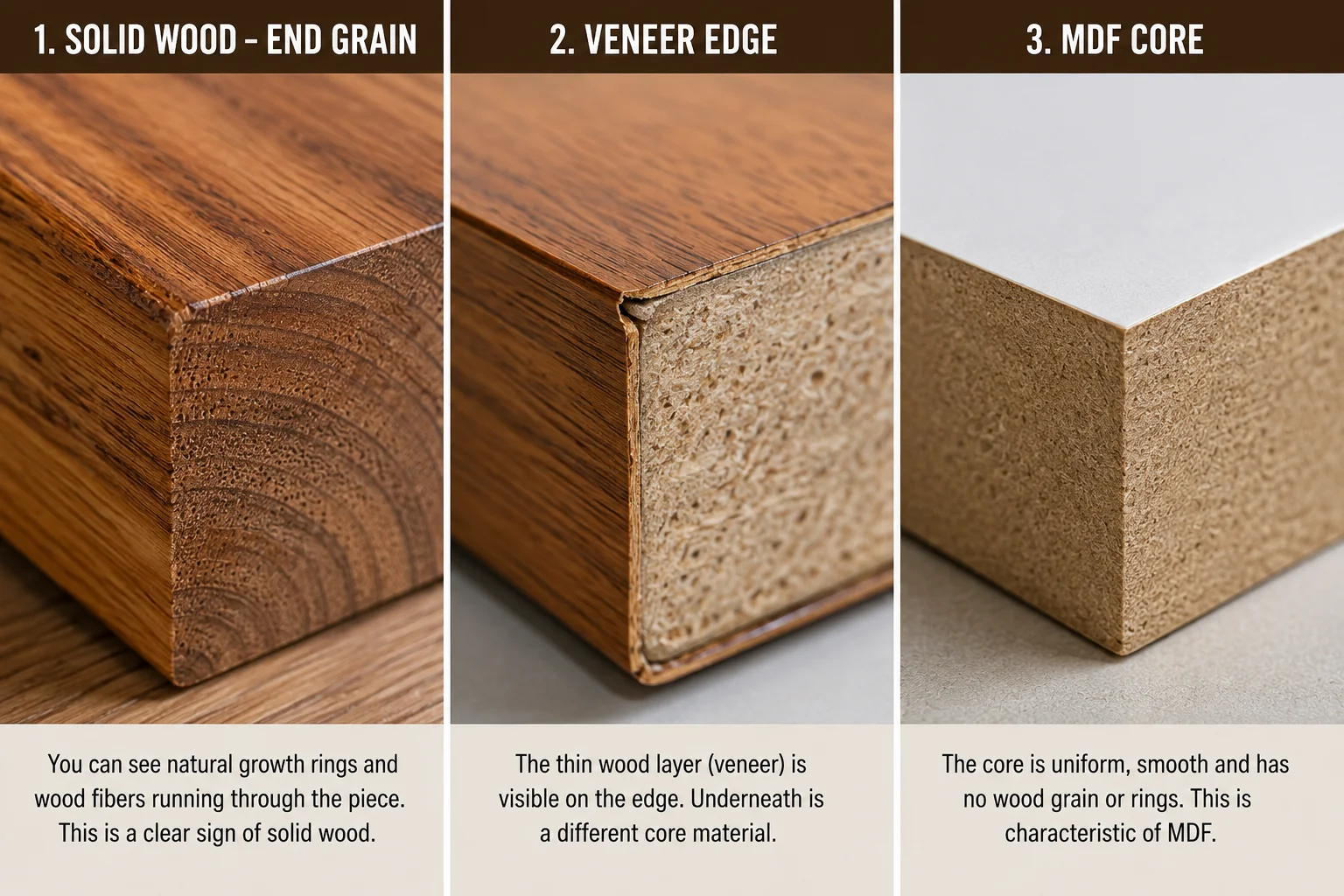
You can tell if furniture is solid wood by examining its exposed edges, end grain, underside, joints and grain continuity. Real solid wood normally shows natural grain variation that continues around corners and remains visible on unfinished areas. Veneered or laminated furniture may show repeated grain patterns, thin surface layers, covered edges or a different material beneath the decorative finish.
No single test provides a completely reliable answer. Weight, colour and price can offer clues, but buyers should combine several physical checks and ask the seller for a written material breakdown before placing an order.
Quick Answer: How Do You Identify Solid Wood Furniture?
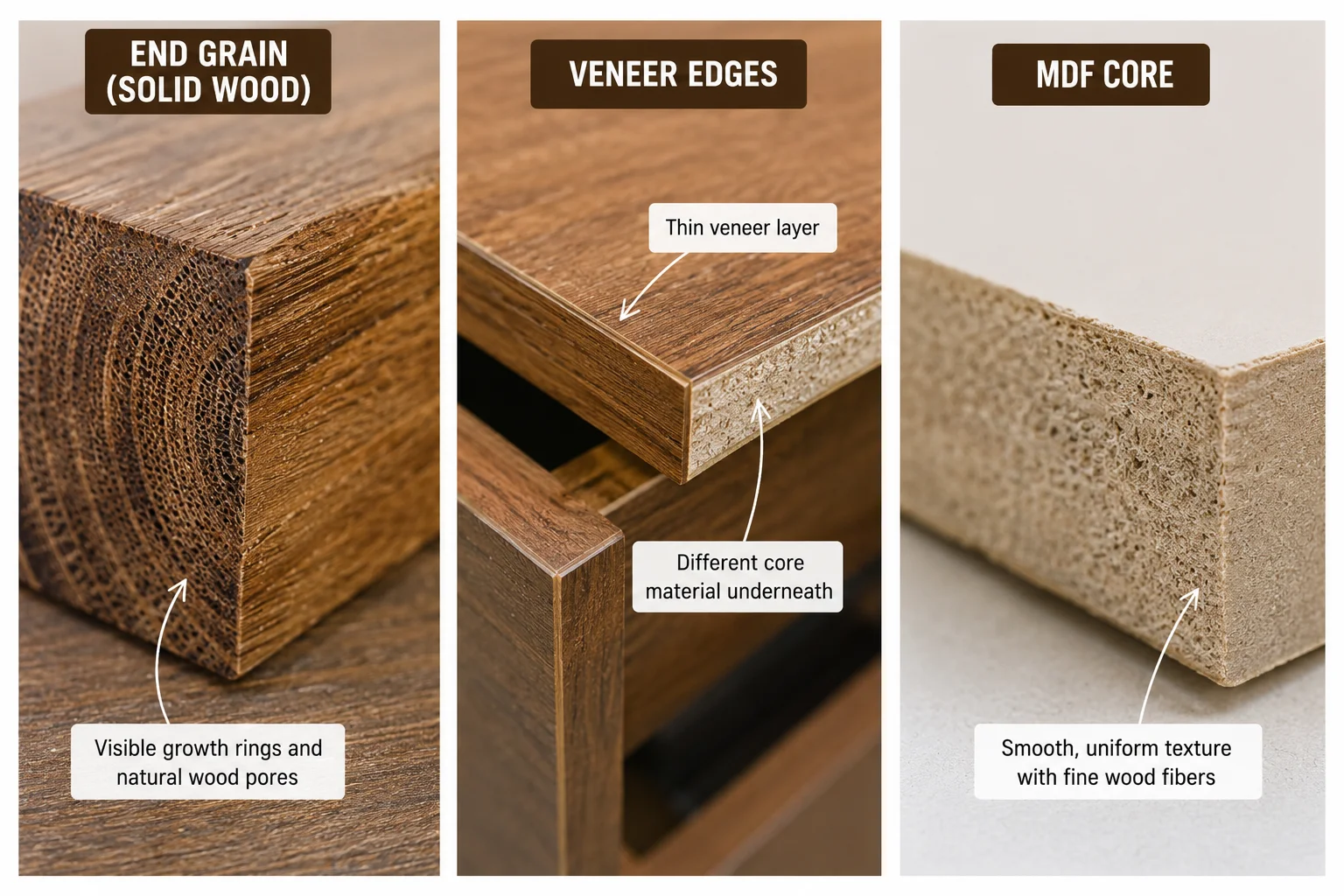
Look for these signs when inspecting furniture:
- Visible end grain on the ends of boards
- Grain that continues naturally around edges
- Different grain patterns across separate wooden components
- Natural variations in colour, knots and texture
- Unfinished wood on the underside or inside
- No thin surface layer peeling from the corners
- Joints cut directly into wooden components
- A written product description that clearly states which parts are solid wood
Solid wood furniture is made from pieces of natural timber rather than panels manufactured from compressed fibres, particles or thin wood layers. However, one item can contain several materials. A bed may have a solid wood frame, an MDF headboard panel, plywood drawer bottoms and veneered side tables.
That combination is not automatically poor quality, but buyers should know exactly what they are purchasing.
Solid Wood, Veneer, MDF and Plywood Explained
Understanding the basic terms makes furniture inspection much easier.
| Material | What It Is | What You May See |
|---|---|---|
| Solid wood | Timber cut directly from a tree | Natural grain, end grain, knots and colour variation |
| Wood veneer | A thin layer of real wood attached to another material | Real-looking grain on the surface but a different core underneath |
| MDF | Fine wood fibres compressed with resin | Smooth, uniform core without natural grain |
| Particleboard | Larger wood particles compressed into panels | Coarse chip-like material visible on damaged edges |
| Plywood | Multiple thin wood layers bonded together | Layered lines visible along exposed edges |
| Laminate | A printed or decorative surface attached to a panel | Repeated grain pattern and no natural wood structure underneath |
Solid wood and engineered wood products behave differently because natural wood has a directional cellular and grain structure, while composite panels are manufactured from fibres, particles or bonded layers. The USDA Forest Products Laboratory treats solid wood and wood-based composites as separate material groups with different properties and applications. (US Forest Service R&D)
For a deeper material comparison, read Gourmet Furnishers’ guide to solid wood vs engineered wood.
Why Furniture Material Descriptions Can Be Confusing
Furniture descriptions often use broad phrases such as:
- Wooden furniture
- Wood construction
- Wood finish
- Wood solids
- Solid structure
- Premium wood
- Hardwood frame
- Sheesham finish
- Walnut colour
These terms do not always mean that the complete piece is made from solid wood.
“Walnut finish,” for example, may refer only to the colour. “Solid wood frame” may describe the supporting structure but not the panels, shelves, drawer bottoms or decorative sections. “Wooden furniture” may include solid timber, plywood, MDF, veneer or several materials used together.
A trustworthy product specification should explain the construction component by component.
Before buying a bed, for example, ask what materials are used in the headboard, footboard, side rails, support structure, side tables, dresser and drawer bases. Gourmet Furnishers’ existing guide on how to check furniture quality before buying covers the wider inspection process, including construction, comfort, hardware and finishing. This article focuses specifically on identifying the material.
12 Checks to Tell If Furniture Is Solid Wood
1. Read the Material Description Carefully
Start with the product label, online description, quotation or invoice.
Look for a direct statement such as:
- Solid Sheesham wood
- Solid Ashwood
- Solid oak
- Solid wood frame with MDF panels
- Plywood structure with wood veneer
- MDF with deco paint
- Engineered wood with laminate finish
Specific descriptions are more useful than promotional phrases such as “premium wooden construction.”
Pay close attention to qualifiers. A “solid wood bed” suggests broader solid timber construction, while a “bed with a solid wood frame” may contain engineered material in the visible panels. Similarly, “Sheesham wood finish” does not necessarily mean Sheesham timber was used.
Ask the seller to identify the material used in every major component. For a wardrobe, this includes the doors, side panels, shelves, back, drawers and internal frame. For a sofa, ask about the internal frame rather than judging the material by its visible legs or arms.
Never assume that the material shown in the title applies to the complete furniture set.
2. Inspect the End Grain
End grain is one of the strongest visual clues when identifying solid wood.
End grain appears where a piece of timber has been cut across the direction of the tree’s fibres. It may show growth-ring curves, pores and a pattern that looks different from the long grain on the face of the board. Wood-identification specialists examine end grain because it reveals anatomical structures that may not be obvious on a polished face. (US Forest Service R&D)
Look at areas such as:
- The end of a table leaf
- The top or bottom of a bed leg
- The edge of a shelf
- The rear of a drawer side
- The underside of a chair rail
- A concealed corner inside a cabinet
A solid wooden board should normally have end grain at its cut end. If the face displays convincing wood grain but the edge has no corresponding end grain, the surface may be veneer or laminate.
Paint, edge strips and heavy polish can hide the core, so this test is not always possible on finished furniture.
3. Follow the Grain Around the Edge
Natural grain should make physical sense as it moves across a solid wooden component.
Follow a visible grain line from the broad face of a tabletop toward its edge. On solid wood, the grain should continue naturally over the edge, although its appearance will change according to the direction of the cut.
On veneered furniture, the grain may stop suddenly at the edge. The edge may display:
- A separate strip
- A different grain direction
- A perfectly uniform colour
- A visible glue line
- MDF, plywood or particleboard beneath the surface
- A printed pattern that does not connect with the top
Corners are particularly useful. Examine them in bright light and from several angles. A thin line between the face and the edge can indicate an applied veneer, laminate or edge band.
Well-made veneer can be applied very neatly, so the absence of an obvious line does not prove that the item is solid wood. Continue with the remaining checks.
4. Look for Natural Grain Variation
No two solid wooden boards are completely identical.
Natural timber can contain changes in:
- Grain direction
- Colour tone
- Pore pattern
- Growth rings
- Mineral streaks
- Small knots
- Figure and texture
These variations usually appear irregularly across a piece of furniture. Even boards cut from the same tree may not match perfectly.
Printed laminate frequently repeats the same visual design. Examine a large wardrobe door, tabletop or cabinet panel and look for identical knots or grain shapes appearing at regular intervals. Repeated details can indicate a printed surface rather than natural timber.
Veneer is real wood, so it can also show natural variation. However, veneer sheets may be arranged in deliberate mirrored patterns known as book matching. A symmetrical grain pattern is therefore not proof of solid wood.
Grain variation helps identify natural material, but it must be combined with an inspection of the core and edges.
5. Examine the Underside, Back and Interior
Manufacturers usually spend the most finishing effort on the visible surfaces. Hidden areas can reveal the furniture’s true construction more clearly.
Inspect:
- The underside of a dining table
- The back of a headboard
- The bottom of a cabinet
- The inside of a wardrobe
- The area behind removable drawers
- The back of a dresser
- The lower surface of shelves
Solid wood may appear rougher or less polished in concealed areas, but the natural grain should still be present.
An MDF or particleboard panel may appear smooth and uniform. Plywood may reveal several thin bonded layers along the edge. A veneered panel may have a decorative wood face on the front and a plain balancing veneer or different surface on the back.
Do not damage a product to expose its core. Use areas that are already visible or ask the showroom representative to show you an unfinished sample of the material.
6. Inspect Drawer Construction
Drawers provide several useful material clues.
Pull a drawer out completely and inspect its:
- Front
- Sides
- Back
- Bottom panel
- Joints
- Screw holes
- Upper edges
A drawer may have a solid wood front while its sides and bottom are made from plywood or MDF. This is a common construction method and does not necessarily make the furniture weak. However, it means the item is not made entirely from solid wood.
Solid wood drawer sides should show natural grain along the face and end grain where the boards terminate. Plywood edges show layers, while MDF has a smooth fibre-based core.
Also examine how the drawer front is attached. A decorative solid wood front may be fixed to an engineered drawer box. Ask whether the advertised material describes only the visible front or the complete drawer.
Strong drawer construction depends on more than the material. Joinery, panel thickness, runners and alignment also affect durability.
7. Check Exposed Screw Holes and Hardware Openings
Existing screw holes and hinge openings can expose the internal material without requiring any damage.
Inspect areas around:
- Wardrobe hinges
- Drawer runners
- Bed fittings
- Table hardware
- Shelf-support holes
- Handles
- Assembly bolts
Solid wood usually shows continuous natural fibres around the hole. MDF has a fine, compressed and relatively uniform interior. Particleboard shows larger chips and particles. Plywood reveals thin layers when the opening reaches an exposed edge.
Damaged corners can also reveal the core, but do not treat damage as a desirable sign. A chipped edge may simply show that the piece has been mishandled.
Hardware performance matters too. Screws must be appropriately selected and installed for the material being used. Poor placement or repeated assembly can weaken the area around a fitting, whether the component is natural or engineered wood.
8. Look for Seams Between Separate Boards
Wide solid wood furniture surfaces are often constructed from more than one board.
A broad dining table, cabinet side or headboard may show narrow seams where boards have been joined edge to edge. Grain patterns typically change at each seam because the individual planks come from different parts of a tree.
A perfectly wide surface with one uninterrupted grain image may be:
- A veneered panel
- A laminated board
- A printed surface
- A particularly wide natural slab
Large natural slabs do exist, but they are generally more expensive and should be described clearly by the seller.
Examine whether the grain pattern changes logically at the seam. A visible joint with an identical printed pattern continuing across both sides may be decorative rather than structural.
Small components such as legs and rails may be cut from single pieces, while larger panels can be assembled from multiple boards.
9. Check Carved, Routed and Shaped Areas
Carved edges and shaped components can help reveal what lies under the surface.
On solid wood, carving exposes more of the same natural material. Grain should remain visible within grooves, curves and cut sections.
On veneered furniture, deep shaping may expose the core because veneer is only a surface layer. For this reason, veneered components often have flatter faces or separate solid edging around heavily shaped areas.
MDF can also be routed and carved into decorative patterns. It produces smooth, consistent grooves without natural grain. Painted MDF furniture may therefore have detailed designs that look precise but do not display timber structure.
Do not assume that intricate carving proves the furniture is solid wood. Modern machinery can cut detailed patterns into MDF, while moulded components can imitate traditional carving.
Look closely inside the decorative cuts. Natural wood grain within the deepest areas is a stronger sign than the pattern itself.
10. Consider the Weight—but Do Not Rely on It
Solid wood furniture is often heavy, but weight alone is not a dependable identification test.
Dense hardwood furniture can feel substantial. However, MDF is also heavy because it contains densely compressed wood fibres and resin. A large MDF wardrobe may weigh more than furniture made from a lighter natural wood.
Construction can further affect weight. Furniture may contain:
- Hollow spaces
- Metal reinforcement
- Thick upholstery
- Glass or marble
- Storage mechanisms
- Multiple engineered panels
A light item is not automatically fake, and a heavy item is not automatically solid wood.
Use weight only as a supporting clue. Combine it with the end-grain, edge, underside and written-specification checks.
When moving the item slightly, also observe its balance and rigidity. A high-quality piece should feel stable rather than twisting, shaking or producing loose sounds.
11. Ask Whether the Furniture Uses Veneer or Engineered Panels
Ask the seller a direct question:
“Which parts are solid wood, and which parts are MDF, plywood, particleboard or veneer?”
Avoid asking only, “Is this real wood?” Veneer contains real wood, and plywood is also manufactured from wood layers. A seller may therefore answer yes without confirming solid timber construction.
Request a component-level explanation. For a bed set, ask about:
- Headboard
- Footboard
- Side rails
- Legs
- Mattress supports
- Side tables
- Dresser frame
- Drawer bottoms
- Mirror backing
For a sofa, ask whether “solid wood” refers to the complete internal structure or only selected frame components.
For a dining set, ask about the tabletop, apron, legs, chair frames, chair backs and decorative panels.
Hybrid construction can be practical when each material is used appropriately. The goal is transparency, not automatically rejecting every engineered component.
12. Get the Material Specification in Writing
The final and most important check is obtaining a written description.
Ask the retailer to include the following on the quotation or invoice:
- Main timber species
- Solid wood components
- Engineered wood components
- Veneer or laminate type
- Finish or polish
- Hardware specifications
- Custom dimensions
- Warranty coverage
- Care requirements
A verbal promise can be difficult to verify after delivery. Written details reduce misunderstandings and give both the customer and seller a clear record of what was ordered.
Gourmet Furnishers publishes separate warranty periods for solid wood structures, structural joints, and paint or polish, subject to its stated terms and exclusions. Customers should review the current warranty and shipping policy and confirm which coverage applies to their chosen product. (Gourmet Furnishers)
What Does “Solid Wood Frame” Mean?
A solid wood frame means the main supporting structure is made from natural timber. It does not necessarily mean every visible or hidden component is solid wood.
For example, a sofa may have:
- A solid wood internal frame
- Plywood support panels
- Foam cushioning
- Upholstered sides
- Engineered decorative sections
A bed may use solid wood for the side rails and legs but use MDF in a wide decorative headboard panel.
This type of hybrid construction can perform well when properly designed. Buyers should focus on whether strong materials are used in load-bearing areas and whether the complete material breakdown matches the price.
When comparing bedroom options, Gourmet Furnishers’ guide to the best wooden bed for long-term use in Pakistan explains how wood type, joinery, support and finishing affect durability. The website also lists models such as the Hemlock Bed and Juliet Bed as solid wood products, although buyers should confirm the current specifications and customization details before ordering. (Gourmet Furnishers)
Is Veneer the Same as Fake Wood?
No. Wood veneer is a thin layer of natural wood applied to another material.
The surface can display real wood grain because it is made from real timber. The supporting core may be plywood, MDF, particleboard or another substrate.
Veneer can be used in both inexpensive and high-quality furniture. It allows manufacturers to:
- Create consistent decorative patterns
- Cover large, stable panels
- Use valuable wood more efficiently
- Reduce the movement of wide furniture panels
- Produce book-matched or decorative grain designs
Laminate is different. It is normally a printed or decorative manufactured surface rather than a thin slice of natural timber.
Therefore, identifying veneer does not automatically mean you have found bad furniture. The important questions are the quality of the core, veneer thickness, adhesive, edge finishing and overall workmanship.
Does Solid Wood Always Mean Better Furniture?
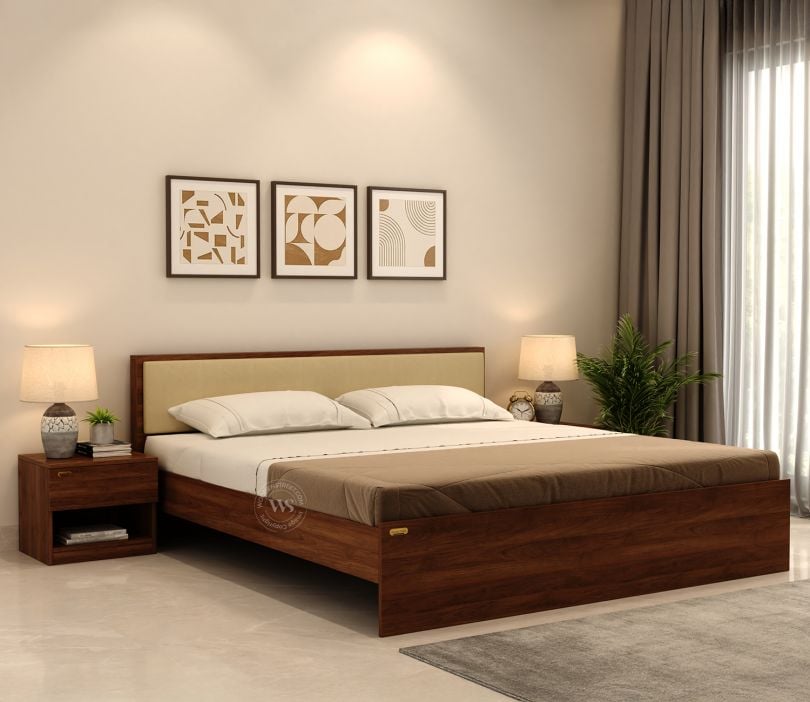
Solid wood has several advantages, including natural character, repairability and the possibility of refinishing. However, the material name alone does not guarantee quality.
Poor solid wood furniture may contain:
- Unseasoned timber
- Weak joints
- Cracks
- Uneven legs
- Inadequate support
- Poor polish
- Insect damage
- Badly selected boards
Well-made plywood or veneered furniture can sometimes perform better than badly constructed solid timber furniture.
The best purchase combines suitable materials with skilled construction. Examine the joinery, alignment, support, finishing and hardware in addition to checking the wood.
For a wider assessment, use the practical steps in How to Check Furniture Quality Before Buying in Pakistan.
Which Furniture Items Benefit Most from Solid Wood?
Solid wood is particularly valuable in furniture that carries weight or experiences frequent movement.
Beds
Bed side rails, legs and central supports must withstand daily weight and movement. Solid timber is often preferred for long-term structural use.
Explore different styles in Gourmet Furnishers’ bed set collection.
Sofa Frames
A sofa’s internal frame supports its users, springs, webbing, foam and upholstery. Buyers should ask about the hidden frame rather than judging quality only by fabric.
Browse the sofa set collection and compare frame construction, seating capacity and customization options.
Dining Tables and Chairs
Dining furniture faces spills, movement, weight and repeated cleaning. Solid wood surfaces can often be repaired or refinished after wear, although they still require protection from standing water and excessive heat.
View available options in the dining room set collection.
Wardrobes and Cabinets
Wardrobes do not always need to be completely solid wood. MDF, plywood and veneer can work effectively for wide doors, panels and internal storage.
Gourmet Furnishers’ wardrobe collection includes MDF, semi-solid and solid wood options, allowing buyers to compare different construction methods. (Gourmet Furnishers)
Common Mistakes When Checking Solid Wood Furniture
Assuming Every Visible Wood Grain Is Solid Timber
Veneer and high-quality laminate can closely imitate natural wood. Always inspect the edges and core.
Believing Heavy Furniture Must Be Solid Wood
MDF can be extremely heavy. Weight is only a supporting clue.
Judging the Entire Product by Its Legs
A table or sofa may have solid wood legs but an engineered main structure.
Confusing Wood Colour with Wood Species
A walnut-coloured finish does not prove that the item is made from walnut. Sheesham, Ashwood, MDF and other materials can all be finished in similar colours.
Rejecting All Veneer and Plywood
Good veneer and furniture-grade plywood can perform well in wide panels, cabinets and decorative furniture. Material suitability and craftsmanship matter.
Accepting Verbal Claims Without Documentation
Ask for the material breakdown on the invoice, especially for made-to-order furniture.
Furniture Inspection Checklist Before Payment
Before paying a deposit, confirm:
| Check | What to Confirm |
|---|---|
| Product description | Exact wood or board type |
| Structural frame | Solid wood, plywood, MDF or mixed |
| Visible panels | Solid wood, veneer or laminate |
| Hidden components | Drawer bottoms, backs and shelves |
| Timber condition | Seasoned, dry and free from visible damage |
| Joinery | Stable, aligned and properly fitted |
| Finish | Evenly applied across edges and concealed areas |
| Hardware | Suitable hinges, runners, screws and fittings |
| Customization | Dimensions, colour and material clearly recorded |
| Warranty | Coverage for structure, joints and finish |
| Delivery | Inspection process and damage reporting |
| Invoice | Complete specifications written clearly |
Price should also be evaluated against the actual construction. Solid timber normally costs more than MDF or particleboard, but design, workmanship, upholstery, finishing and customization also influence the final price.
Read What Is the Average Furniture Cost in Pakistan? for a broader explanation of furniture pricing and material costs. (Gourmet Furnishers)
Final Verdict
The most reliable way to tell if furniture is solid wood is to combine visual inspection with written confirmation.
Start by examining the end grain, edges, underside, drawers, hardware openings and hidden surfaces. Follow the grain around corners and look for natural variation instead of repeated printed patterns. Ask which components use solid timber, veneer, plywood, MDF or particleboard.
Do not rely only on weight, price, carving or the words “wooden furniture.” These clues can be misleading when considered alone.
Solid wood can be an excellent long-term choice for beds, sofa frames, dining tables and other heavily used furniture. Veneer, plywood and MDF can also be appropriate for panels, wardrobes, cabinets and decorative sections when the materials are honestly described and properly constructed.
A good furniture purchase is not defined by one attractive surface. It is defined by transparent specifications, suitable materials, skilled workmanship and dependable after-sales support.
Frequently Asked Questions
How can you quickly tell if furniture is solid wood?
Check an exposed edge or the underside. Solid wood usually shows natural grain through the material and visible end grain at the end of a board. Veneered furniture may have a thin surface layer over a different core.
Can solid wood furniture have veneer?
Yes. Furniture may have a solid wood frame with veneered panels. The frame may still be solid timber, but the complete item should not be assumed to be solid wood throughout.
Does solid wood have repeating grain patterns?
Natural timber has irregular grain variation. Identical knots or grain shapes repeated across a large surface may indicate printed laminate. Veneer is natural wood and can show intentional symmetrical patterns.
Is MDF heavier than solid wood?
MDF can be heavier than some natural wood species because its fibres are densely compressed. Weight cannot reliably identify solid wood without other checks.
Is plywood considered solid wood?
No. Plywood is an engineered wood panel made by bonding multiple thin wood layers together. It can be strong and useful, but it is not the same as a solid timber board.
Is veneer real wood?
Wood veneer is real wood cut into a thin sheet and bonded to a core material. It differs from laminate, which usually uses a printed or synthetic decorative surface.
How do you tell solid wood from veneer on a tabletop?
Compare the top with the edge. On solid wood, the grain structure should continue logically around the edge, and the end of the board should show end grain. Veneer may stop at a thin seam or cover a different core.
Are solid wood beds better?
Solid wood is generally a strong choice for bed frames because it can support substantial daily weight and may be repaired or refinished. Joinery, seasoning and support design remain equally important.
Should every wardrobe be made from solid wood?
Not necessarily. MDF, plywood and veneer can work well for wide wardrobe doors, shelves and panels. The best choice depends on budget, climate, construction quality and expected use.
What should be written on a furniture invoice?
The invoice should identify the wood species, solid wood components, engineered materials, veneer or laminate, finish, dimensions, hardware, customization and warranty terms.
Can painted furniture be solid wood?
Yes. Solid wood can be painted, but paint hides most grain clues. Inspect unfinished areas, edges, joints, screw holes and the underside, and ask for a written material specification.
What is the safest way to confirm solid wood furniture?
Ask the manufacturer for a component-by-component material breakdown in writing. Combine that information with a physical inspection before paying the final amount.
Before publishing, add original close-up photographs of end grain, veneer edges and MDF cores. These firsthand visuals would strengthen the article’s usefulness and make its 12 checks easier for Google’s systems and customers to understand.
Leave a Reply
You must be logged in to post a comment.